
















Week 340
It's week 340 and we are thinking about the role of standards in education and what happens when we ...

Jump to: Top Tasks | From the Field | Key Resources | Moments of Resilience
It is week 324 and we are thinking about AI-assisted creation and the problem of the bland, perfect sameness creeping into the way we think and express ourselves.
“I am a big fan of technology. I’ve blissfully given over my spatial reasoning to Google Maps. I use artificial intelligence to chase down articles, do research, fix my grammar mistakes and whip up last-minute school-night recipes. But I’ve recently drawn a sharp line in the sand: no AI for writing,” writes Brookings’ Rebecca Winthrop in a new Op-Ed for the New York Times.
One reason is the increasing evidence that an over-reliance on AI is reducing our capacity for new perspectives and ideas. Winthrop points to research by Georgetown University neuroscientist Adam Green, who found that “human-written essays offered up to eight times more new ideas than those produced by AI.” In another study by a different team, Winthrop reports, “As with the student essays in Dr. Green’s study, AI-assisted works had more interesting vocabulary and were rated more enjoyable to read, but the underlying story lines were more homogeneous. Distinctive and offbeat ideas — with surprising characters or unusual settings — are often shunted to the side when AI is involved.”
This makes sense when you realize that all AI models are trained on what has already been written. They are a perfect reflection of what was written in the past and therefore make a poor roadmap for the future. Given that, the findings of a new study by Merrimack College’s Dan Sarofian-Butin are particularly troubling. In his analysis of a sample of 100 education doctoral dissertations published in 2025 using the Pangram detection tool, he found that “56% of dissertations contained more than negligible (>10%) AI-generated writing; moreover, 19% of dissertations contained more than 50% AI-generated text.”
You read that right: the majority of text in nearly one-in-five education dissertations published last year was generated by AI. And in one-in-20 dissertations, more than three-quarters of the text was found to be AI-generated. Not only does this call into question the legitimacy of the degrees being conferred but it also means that increasingly the education leaders we are entrusting to help guide students through this era are themselves choosing a path of least resistance over the productive struggle that most often leads to new ideas and personal growth.
Last time in the New Reality Roundup, we shared The State of Educational Opportunity in California report, looked into the Education Scorecard and shared new research on the positive benefits of auto-enrollment in advanced math courses. This week, we look at what districts and advocates can do now that “the Big Shrink” budget crisis is here and examine the dramatic, bipartisan popularity behind the public funding of students for summer programs.
“As many school boards debate their budgets for the upcoming school year, a Chalkbeat analysis found a common thread: More than half of the country’s 50 largest school districts are poised to or already have made cuts, or are facing a reported deficit,” Lily Altavena writes for the outlet.
This likely won’t come as a surprise to readers of the Roundup, who have heard warnings from Marguerite Roza and Chad Aldeman since 2022 on the fiscal challenges that would beset districts when ESSER funds ran dry amidst a declining school-age population and more families taking advantage of school choice programs.
Altavena shares the example of one district in Florida to illustrate how the budget pressure is being experienced on the ground: “Broward faces a $90 million budget deficit …To try to close the budget gap, district officials are cutting 1,000 positions. Of those, 700 are already vacant — the other 300 will be layoffs.”
While local frustrations are bubbling up in Broward, their commitment to resolving the budget crisis through hard choices will leave them on more secure ground in the future. In other states, such as Colorado and New York, legislatures have stepped in with additional funding to shield or “hold harmless” under-enrolled districts from cuts. In Vermont, property taxes have risen 40% over the past five years, due primarily to under-enrolled districts.
William E. Simon Policy Fellow Danyela Egorov has been sounding the alarm over rising per pupil costs in New York, and chimes in with a warning for Roundup readers, “Districts should absolutely not follow New York’s example, which spends $388 million every year to finance empty schools. Mayors and superintendents of large districts will have to manage declining enrollment over the next few years. Either they will have to merge and close schools or make their schools so attractive that families decide to re-enroll their kids.”
The Edunomics Lab’s Marguerite Roza, who named the current belt-tightening as the “Big Shrink” agrees, suggesting that navigating the challenges is going to require difficult choices and hard work. That hard work, in Marguerite’s view, is now unavoidable. “Part of the work will involve scrutinizing existing programs to decide which deliver measurable value for the dollar … Some districts will need to close schools or risk spreading dollars too thin across too many buildings. Our rule of thumb is that closing 1 of every 15 under-enrolled schools saves about 4% of a district’s budget, mostly in labor costs,” she wrote last December.
As for Marguerite’s current take? “The fiscal cliff is no surprise. It’s been right there in district multi-year financial forecasts. Lots of districts used one-time Covid money to add staff and raise pay. What we’re seeing now is the fallout now that relief funding is gone. Some chose to spend down reserves to put cuts off a year. But math is math.”
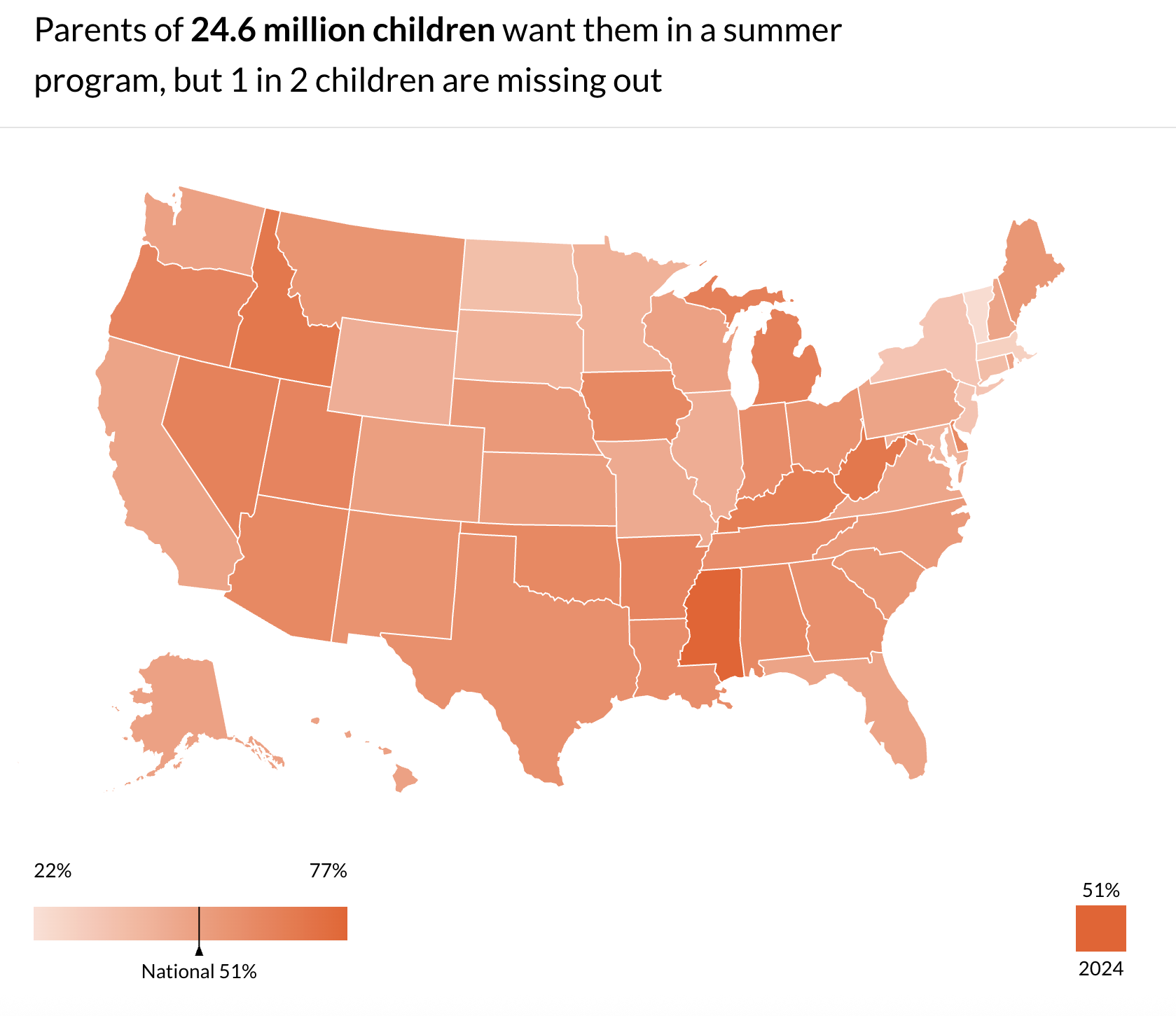
With the school year coming to an end, Afterschool Alliance released national polling results and an accompanying report, “The Summer Struggle for Everyday Families: Affording the Opportunities Parents Want for Youth.” The headlines mirror findings from the Educational Opportunity Survey, released in February: 24.6 million families want a summer program and 12.6 million families do not have access, primarily due to costs and transportation. That unmet demand is not uniform across the country.
Nearly 4-in-10 families cited program costs as the primary reason that their student couldn’t participate in a summer program, compared to 18% who indicated transportation challenges, the next highest reason. Those cost challenges are particularly felt by families that are already struggling; high-income families are attending summer programs at three times the rate of low-income families.
The solution recommended by Afterschool Alliance is to increase the public funding of these programs, with the authors pointing to Oregon’s Summer Learning Grants as a model. Those grants, funded by the state legislature, provide money to quality programs with a focus on those that enroll low-income students and provide transportation.
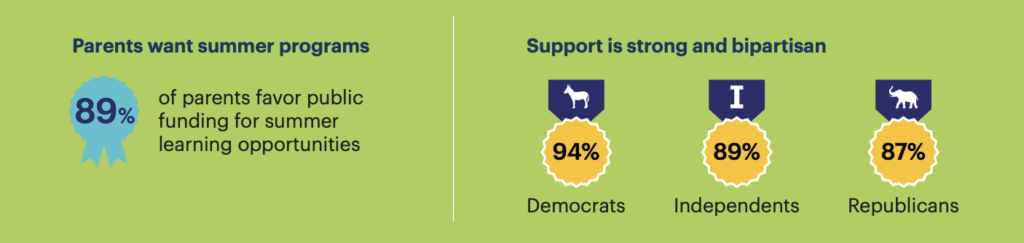
Elected officials should note that public funding of summer programs is a political winner, with an immense degree of public support across partisan lines. The Afterschool Alliance polling found 89% parental support with similar support for Democrats, Independents and Republicans.
 “HawaiiKidsCAN is helping shape the future of literacy and driving statewide change for our kiki,” reported Hawaii News Now anchor Lauren Teruya as she introduced HawaiiKidsCAN Executive Director David Miyashiro, in a profile and interview that traced his journey from a special education teacher to securing his big win on literacy earlier this year.
Brookings hosts a webinar on June 8 that examines the past, present and future of America’s school boards.
Rick Hess at Education Next interviews Knowledge Matters’ Matthew Levey on the link between history and civics instruction and improved reading scores.
The Walton Family Foundation and Gallup released a new poll of teachers, finding “most teachers are unclear about how AI tools should be used in their work.”
A new study at Ed Working Papers states that the replacement of school accountability policies with executive actions during both the Trump and Biden presidencies focused on racial equity, gender and curriculum have “produced policy regime decay.”
The San Francisco Chronicle reports that hundreds of faculty in the University of California system signed an open letter last week asking leaders to require standardized tests for admissions due to “preparation gaps so severe that instructors must reteach middle-school mathematics.”
Urban Institute offers advice to state governments on how they can support apprenticeship programs, including tax credit incentives and modernizing systems.

14 year-old Shrey Parikh not only won the Scripps National Spelling Bee last Friday, but set a new all-time record after rattling off 32 correctly spelled words in the competition’s final “spell off” round. Last up in the round was the final word that sealed Shrey’s victory: bromocriptine, a medication that stimulates dopamine receptors. “Shrey said he spends about five hours per day practicing his spelling,” Sophia Solano writes in the Washington Post. “He’s not sure yet what he’ll do with his suddenly expansive extracurricular time. But he’s leaning toward math problems.”