
















Week 344
It is week 344 and we are asking ourselves: what’s the evidence that education policy reforms actu...

Jump to: Top Tasks | From the Field | Key Resources | Moments of Resilience
It’s week 330 and we are thinking about what it takes to have high standards for learning when the status quo is trying to obscure the truth.
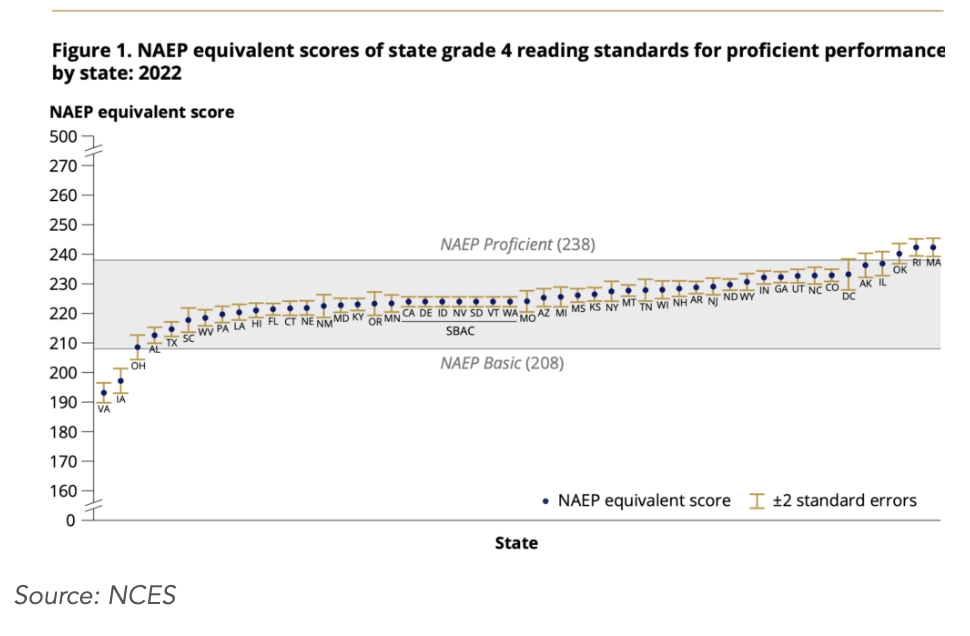
“Lots of questions over the past few weeks that can be roughly aggregated and summarized as ‘WTF in Virginia?’” Andy Rotherham writes in a new piece at Eduwonk.com. Virginia has the biggest disconnect in the country between what the state labels as proficient and what counts as proficient on the NAEP. In fact, in fourth grade reading Virginia’s proficiency level doesn’t even reach the bar of NAEP’s basic label.
The state had developed a plan to raise the bar on proficiency starting this year. “Flash forward a few months and in late June, out of left field, the Spanberger Administration put a proposal in front of the board to delay the phase-in of higher standards for two more years,” Rotherham reports. “This was obviously politically disastrous in terms of Spanberger’s avowed commitment to higher standards, including a day one executive order, and the moderate image she seeks to cultivate.”
After an outcry on social media, “the state board rejected the proposal 7-0 … But the main takeaway here is that pressure to keep standards low, and happy talk about how great the schools are, is high — and it’s not going to stop until a more performance-focused culture takes hold,” Rotherham concludes. “Easier said than done because Virginia doesn’t have an … EAO [Education Advocacy Organization] in the commonwealth. That will continue unless philanthropy steps up and helps change the game around parent organizing so there is some effective counterweight to an establishment and political network committed to resisting higher standards and more honest reporting to families and the public.”
Students need advocates who consistently and forcefully put their interests first. As Virginia reminds us, ed reform needs to be everywhere kids are and that requires us to think bolder about a 50-state advocacy strategy that leaves no one behind.
Last time in the New Reality Roundup, we looked at expanding summer in the wake of strong results emerging from Bloomberg Philanthropies’ Summer Boost program and celebrated with DelawareKidsCAN’s Britney Mumford as she scored a big win on comprehensive reforms to the student funding formula that had been untouched since the 1940s. This week, we highlight Nat Malkus’ newest advice for districts dealing with chronic absenteeism and count the chickens coming home to roost as California considers their wayward “test blind” admissions policies.
Focus on the “unexcused” to solve chronic absenteeism
“School districts still struggling with stubbornly high chronic absenteeism would do well to take a granular look at their students’ attendance data, specifically their numbers of unexcused vs. excused absences rather than absences in the aggregate,” reports Caitlynn Peetz Stephens for Ed Week, drawing on the work of AEI’s Nat Malkus. “Among the AEI report’s key findings: Unexcused absences were more common among students from historically disadvantaged groups. And the missed days of students in the top 20% for absences were primarily unexcused, meaning that chronic absenteeism—when students miss at least 10% of school days—was disproportionately driven by unexcused absences.”
Malkus’ research suggests that the traditional way that the majority of American schools track absences isn’t sufficient to curb the problem of chronic absenteeism, which deepened during and after the Covid-19 pandemic. “Of the 41 states that have reported data from 2024-25, 34 have shown declining rates of chronic absenteeism, but none have returned to pre-pandemic levels, according to the tracker,” Stephens writes.
Nat is urging district and state leaders to focus their attention on unexcused absences, particularly for low-income students, where 49% of absences are unexcused, compared to 32% of their higher-income peers. Black students’ absences are unexcused at over twice the rate of white students, 67% vs 32% respectively. “We believe if you push hard on those absences, have strong rules and expectations and get people to take unexcused absences seriously, they’re probably going to start taking all absences more seriously,” Nat shared.
To help district leaders in the process, AEI and Malkus have launched a new absence forecasting tool, which models predictive factors to identify the students most at risk of chronic absenteeism.
Call out the fallacies of test blind admissions in higher ed and test blind accountability in K-12
“To throw out the SAT and ACT because they show demographic gaps is akin to canceling the government’s publication of the unemployment rate because it shows similar gaps,” chides The New York Times Editorial Board, in advance of the California Board of Regents’ July 14 vote on whether to bring back the SAT and ACT. “Trying to deny a problem rarely helps solve it. The University of California is now rejecting students who would excel there, including low-income and minority students, and accepting growing numbers of students who flail.”
The Times’ editors offer a brief history of how this problem was created in the first place: from the national anti-testing push that claimed standardized testing–both in college admissions and in K-12 school accountability–was racist and classist, to the 2020 Board of Regents’ meeting where state leaders ultimately “succumbed to the fad of the moment.”
And the Times pulls no punches when summing up where the road of test blind admissions has led us: “The results have been terrible. At the University of California, San Diego, a faculty group last year reported ‘a steep decline in the academic preparation’ among entering students. Last fall, for example, nearly 12 percent of first-year U.C.S.D. undergraduates were not qualified to take precalculus, a low-level class — up from only 0.5 percent in 2020. ‘The key problem is that many of the students coming in do not know algebra,’ said Mina Aganagic, a Berkeley physics professor. More than half of entering Berkeley students who took a math placement test incorrectly answered basic questions (such as solving for x in x²> 4).”
For those of us in the K-12 education sector, this debate is deja vu of the last decade, where an anti-testing coalition made up primarily of union-affiliated groups spent tens of millions of dollars to undermine standardized testing and to undercut their role in evaluating districts, schools and individual classrooms. In Massachusetts, the union spent $15 million to successfully rollback the state’s long-standing high school graduation exam. The California and New York unions have poured tens of millions more into infrastructure for the “opt out” movement.
The consequences are now apparent: students paying tuition for remedial education they should have received for free in middle school and high school, parents with limited insight into how their children are actually performing academically, and a system that is more opaque and less equitable.
“We’ve seen a really intentional strategy come to light,” TennesseeCAN Executive Director Chelsea Crawford told the local ABC affiliate in an interview on state test scores rising for the fifth consecutive year and sitting now above pre-pandemic levels.
JerseyCAN’s teacher and parent fellows are already making an impact statewide from Trenton to Irvington, and talking about their fellowship experience “This fellowship showed me that my voice matters, not just for my children, but for parents who often feel unseen and unheard in their educational journeys,” fellow Vanessa Johnson-Pearson told The Observer.
50CAN William E. Simon Policy Fellow Danyela Egorov published a new piece at City Journal and the Washington Post, critiquing Mayor Mamdani’s ballooning education budget in New York despite dismal academic results.
50CAN National Voices fellow Thibaut Delloue writes on lessons Florida can learn from other southern states in the Orlando Sentinel. Thibaut will also be stepping into the role of chief of staff at South Carolina Children’s Fund. And congratulations to National Voices fellows Alec Macauley and Keith Jacbos, who have also accepted new roles. Alec will be taking on the role of Executive Director of Advocacy and Outreach at Third Future Schools and Keith has stepped in as Vice President of Public and Charter School Services at Step Up for Students. Meanwhile, fellow Natalie Mack successfully advocated for a change to the military’s Joint Travel Regulations to recognize homeschool curriculum, resulting in reduced costs for military homeschooling families, and secured congressional sponsorship for the COMPASS Act to improve educational continuity for military homeschool students.
On July 22 at 1:00 pm ET, DFER is holding a panel discussion on the state of microschools in America, with focus on funding, regulatory and accountability questions.
Linda Jacobson at The 74 Million reports that language in the federal regulations has Don Soifer of the National Microschooling Center and others alarmed that some states will attempt to exclude microschools from the federal scholarship tax credit.
Half of teachers in Georgia are using AI, with the majority of AI-use being directed to lesson planning and classroom preparation, reports The 74 Million.
Brookings provides a new tracker of legal challenges to the Trump administration’s executive actions related to K-12 education, from withholding federal funds to inter-agency department moves.
New America reviews education budgets for states in New England, examining student funding models, external and internal risks and safeguards that should be put in place before the next economic downturn.
Foster care students and students in the criminal justice system could benefit from expanded apprenticeship programs, and the WorkRise Network at Urban Institute offers a roadmap to doing so.
Michael Horn and Joe Ross, writing for Education Next, argue that with college attendance rates dropping, undergraduate programs should reinvent themselves as career-connected learning that takes best practices from apprenticeship programs.

18-year-old Alaysha Hayes shows off the latest creation of her fledging business, Alay Customs, that was developed as part of an entrepreneurial class at the Detroit Boys and Girls Club, now housed in the restored and converted Michigan Central Station. Designed by the same architect as Grand Central Station, the Beaux Arts platforms and concourse have been transformed from a dilapidated rail depot into a 30-acre community landmark, with 17,000 feet being devoted for students to develop their entrepreneurial skills and build businesses. At The 74, Patrick O’Donnell tells the story of these young business leaders.