















Week 342
It is week 342 and we are thinking about how the education reform conversation changes when everyone...

Jump to: Top Tasks | From the Field | Key Resources | Moments of Resilience
It is week 322 and we are returning to the findings from our Education Opportunity in America survey to put the spotlight on the Golden State.
As part of our survey of 23,000 parents across the country, we surveyed 822 parents in California about their experiences with the education system, the opportunities their kids are taking advantage of and their thoughts on the education policies under debate. We decided to bring these California-specific findings together into their own report: The State of Educational Opportunity in California.
Among the most interesting California results:
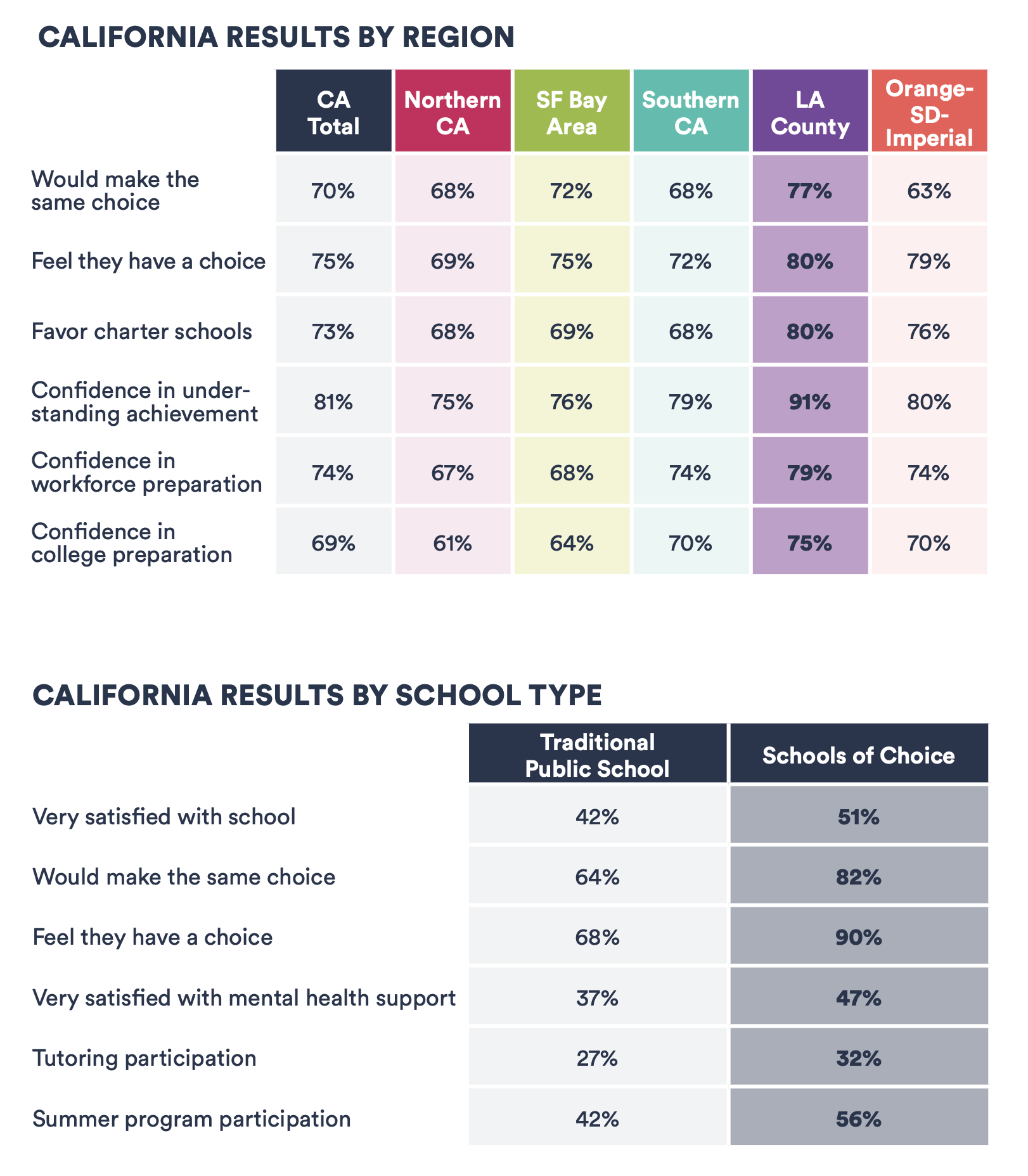
This California report is one of a dozen state specific reports we have produced with state partners since the beginning of the year and builds upon a treasure trove of data that we have made available for free through our data explorer and through access to the complete dataset.
Last time in the New Reality Roundup we looked at needed implementation improvements for the science of reading, and the skyrocketing per-pupil expenditures in New York and elsewhere. Since then, the conversation over New York’s education budget has reached a fever pitch, and we have more for you in From the Field below.
This week, we dive into the learning recession reported by the Education Scorecard, take stock of ConnCAN’s six wins this legislative session and check out new research showing that auto-enrollment in advanced math is a policy that should spread quickly from statehouse to statehouse.
Chart a path out of the learning recession
“The United States entered a ‘learning recession’ in 2013 that it has struggled mightily — and thus far ineffectively — to escape, according to a report unveiled Wednesday by a group of respected social scientists,” writes Kevin Mahnken for The 74 Million on the release of the Education Scorecard, led by Harvard’s Thomas Kane and Stanford’s Sean Reardon. Unlike the NAEP, which uses the same assessment across the country, the Education Scorecard utilizes a common national scale to create an “apples to apple” comparison across different state tests.
To get the full picture of all the problems they uncovered across the country we encourage you to read the full report, but given all the glum news we wanted to make sure that the positive state and district examples didn’t get lost.
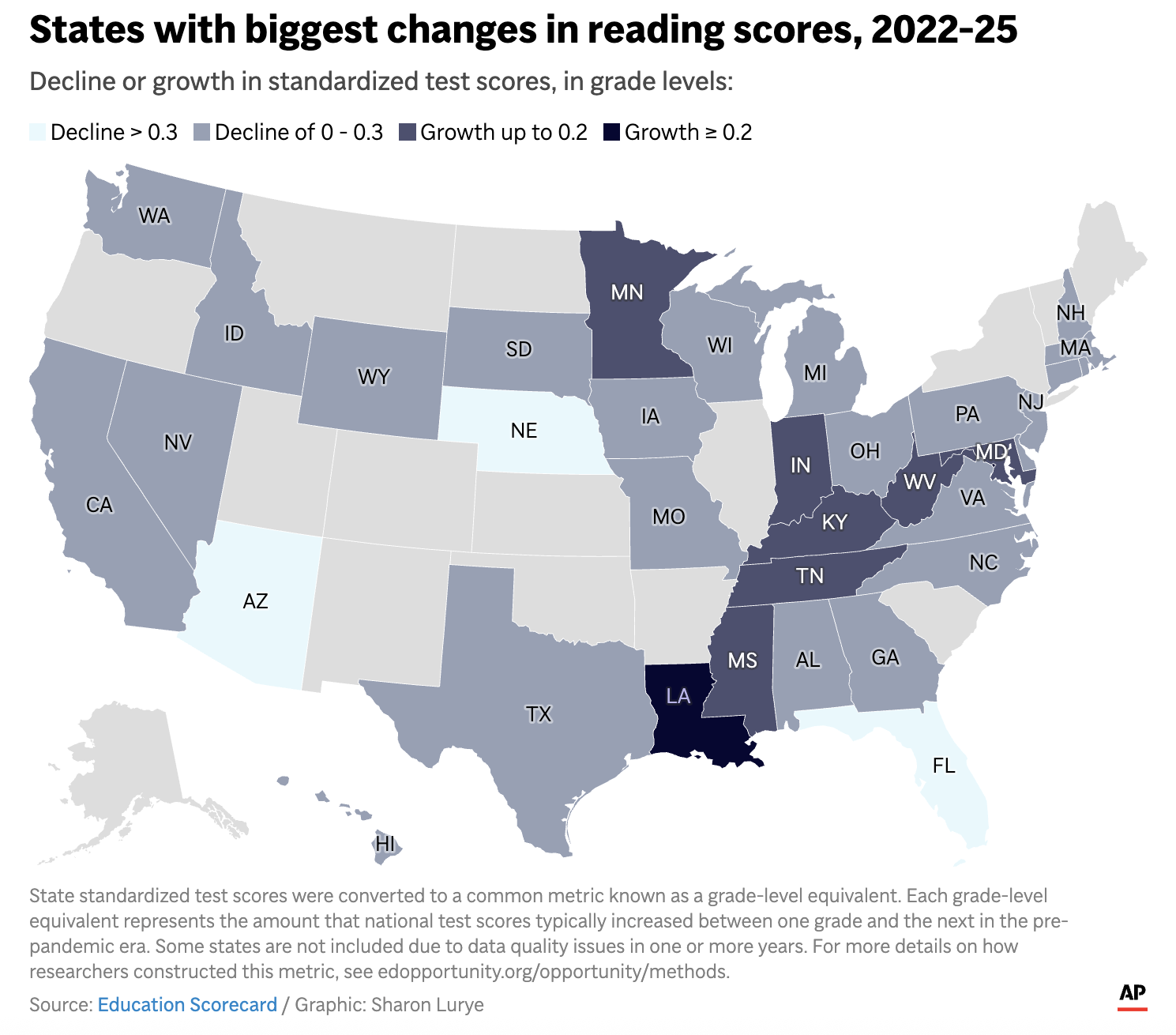
“Louisiana and Alabama were the only states where math scores were higher in 2025 than pre-pandemic,” Chalkbeat writes. “Louisiana is also the only state that beat its pre-pandemic average in reading, with 87% of traditional public school students attending a district where scores are higher than in 2019.” Tennessee was another bright spot, ranking second in math recovery and fourth in reading recovery, with TennesseeCAN Executive Director Chelsea Crawford telling the Tennessee Firefly that the Scorecard “indicates Tennessee’s K-12 education policies and investments to improve student outcomes are working.”
Chelsea told us more about what led to the progress: “The Tennessee Literacy Success Act really paid off in reading gains, and without a lot of fanfare, we worked with the Department of Education to apply those same lessons to math, with ongoing teacher training and resources at the center of the support. I think further gains are on the horizon, especially after this session where we required every school in the state to offer advanced math.”
We asked Kelli Bottger, Executive Director of Louisiana Kids Matter for her take. Here is what she said: “For people looking to implement a similar playbook, here’s what we did over the past several years: high dosage tutoring, teacher training in the science of reading and numeracy, K-3 literacy and numeracy screeners and leaders at every level insisting on instructional excellence with accountability for results. This wasn’t the work of one year or one leader, but took a long-term collective effort.”
If you want to go even deeper, the research team behind the Education Scorecard also identified “Districts on the Rise.” These 108 districts are making significant progress, with 23 districts–including 7 from CAN states–highlighted as case studies available to advocates and educators.
Here’s some of the themes that emerge from these case studies of what these districts are focused on:
The release of the Education Scorecard has garnered significant media attention, providing a real opportunity for advocates to host conversations with electeds and the public on the policy changes that will spur an escape from the learning recession.
Pass and implement advanced math auto-enrollment
New research published at Ed Working Papers finds strong backing for a policy that has been pursued by a number of states across the 50CAN network over the past two years: automatically enrolling students in advanced math courses based on their test scores, rather than waiting on teacher recommendations.
“Students who had the opportunity to take advanced math earned higher math test scores, completed more rigorous high school coursework, and were more likely to attend a four-year college,” UCLA researchers Carrie E. Miller and Meredith Phillips write. “These effects largely hold across student subgroups and are relatively robust to omitted confounders.”
The issue is one of access. Enrollment in advanced math courses has declined 10% across the country over the past decade, though those declines haven’t been evenly distributed. In Los Angeles, the primary district studied by the researchers, advanced math enrollment is down 40%.
“And now you see why I was so passionate about this issue,” Michael O’Sullivan, Executive Director of GeorgiaCAN says, referencing his win this year on a math reform package that included automatic enrollment, along with instructional supports and mandated core instructional time requirements. “When we remove arbitrary barriers to advanced courses, we allow more students to reach their full potential. And, in doing so, could potentially alter their entire life trajectory.”
Other states have heard the call as well. In Tennessee, Chelsea Crawford successfully passed legislation to require all schools in the state to offer advanced math courses as a foundational step. In Delaware, Britney Mumford is working with legislative partners to introduce an auto-enrollment bill and predicts it will be introduced this week. In North Carolina, Marcus Brandon has set an auto-enrollment goal and reports progress being made; the bill had a committee meeting earlier this month
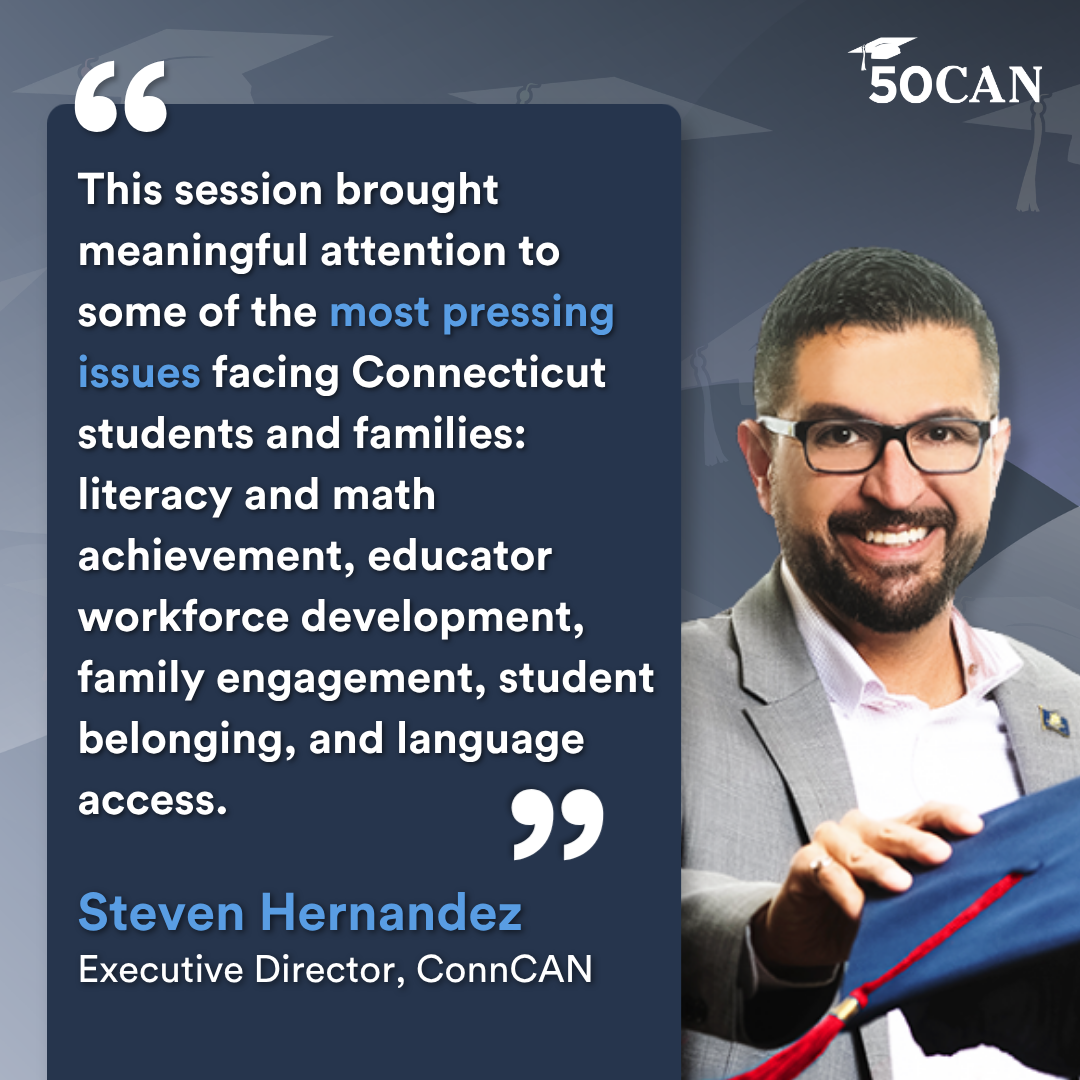
ConnCAN closed out its 2026 legislative session with six wins, including three charter schools that are now funded and slated to open. The wins included:
For much of 2026, 50CAN William E. Simon Fellow and Manhattan Institute Fellow Danyela Souza Egorov has been spearheading what has become a citywide conversation over the cost of education in New York. Discovering that under the new Mamdani budget expenditures have risen to over $44,000 per pupil, Danyela’s work found itself on the cover of the New York Post and at the center of a viral conversation on social media, including a response from the mayor.
Using data from the Educational Opportunity Survey, James Schuls looks into where the wealthy are sending their children to school and the implications of those choices.
A study of Indiana’s charter schools at Ed Working Papers, during and after the Covid-19 pandemic, finds that charter schools contributed to stronger post-pandemic recovery.
Teacher-student conflict in early elementary grades cascades into worse outcomes when students are 26 years old, states new research at Ed Working Papers.
At Alexander Russo’s The Grade, Abraham Kenmore examines how education reporters are using AI to assist their journalism.
Urban Institute asks how reliable LLMs are at parsing public data and finds that between incorrect information presented as fact and struggling to find and utilize specific data points, the tools aren’t great yet.
A new analysis by The Economist finds that recent college graduates in fields more exposed to AI have experienced markedly worse employment outcomes.
At Fordham, Sean Dougherty calls for additional research into the value of CTE credential programs, along with previewing some of the most promising upcoming projects.

Acquiring a degree while having children at home to care for can be really hard, and the Metropolitan State University of Denver wanted to honor its 2026 parent-students graduates who rose to the challenge. Over 30 families participated in a special graduation ceremony, where children draped tassels over the necks of their parents, turning graduation into a celebration of family. Nationwide, one in five college students are also parents. Chalkbeat has more.