








Week 348
It is week 348 and we are thinking about the need to push back on the growing “edu pessimism” am...

Jump to: Top Tasks | From the Field | Key Resources | Moments of Resilience
It is week 348 and we are thinking about the need to push back on the growing “edu pessimism” among the political class and articulate a positive vision of what smart educational investments can do for kids and the country as a whole.
In the wake of the big blue wave earlier this month, there is a heated debate on the left about the role education should play in the Democrats’ new agenda. Over at The Argument, their “Mad Libs” series—where liberals debate hot topics—features a back and forth between journalist Kelsey Piper and socialist writer and “committed education pessimist” Freddie deBoer.
As the quality of educational research has improved, many much-hyped educational interventions—from class-size reductions to preschool expansion to urban charter growth—have been shown to lead to more modest long-term impacts on children than many advocates initially claimed. These findings lead deBoer to claim: “Interventions that are often treated as transformative just don’t appear to matter” and “The result is a very bare cupboard when it comes to finding educational interventions that ‘work.’”
Piper rebuts this argument in two ways. First, she argues that “Almost all improvements look trivial if you zoom out enough and look at a sufficiently distant downstream variable. Take, say, measles vaccination: My best estimate is that going from no vaccination to full elimination only improved average U.S. life expectancy by 20 days.” That does not mean the measles vaccine doesn’t matter, Piper argues, just that no single intervention is enough to dramatically change long-term life outcomes for the population as a whole. The same logic holds true for education, she points out. While the “effect of any individual specific intervention might be quite small,” collectively they can add up to meaningful improvements in student outcomes over time. In our quest to nail down the precise impact of each intervention, we end up underselling the overall collective impact of these reforms.
Second, Piper argues that we have evidence of exactly this kind of large-scale impact from multi-issue, long-term investments at the state level: “In 2024 in Mississippi, 53% of black eighth-graders read at an NAEP ‘basic’ level or above …In Wisconsin, it’s 37% … The Mississippi kids are poorer than the Wisconsin kids, so it isn’t that.” The most likely explanation is that Mississippi simply adopted better policies, and implemented those policies more effectively, over the past decade and a half.
Where does this leave education advocates? We should be careful when we make claims about the scale of the impact of any one intervention but not shy away from asserting the collective importance of educational reforms as a whole. We can make our education system work better for all kids when we secure a wide range of evidence-based reforms that collectively transform a child’s educational journey. And that is what Believe in Better is all about.
Last time in the New Reality Roundup, we looked at how declining enrollment is also affecting schools of choice and examined how CTE programs could benefit from aligning toward goals and outcomes. This week, we celebrate 10 years of HawaiiKidsCAN on the eve of the 2026 CAN Summit and consider 13 policy ideas from Chad Aldeman.
Join us in celebrating HawaiiKidsCAN as it enters its 10th year
Each year, the 50CAN network gathers for our annual CAN Summit, and this week staff, fellows and our local and national partners will gather on Maui to learn from and celebrate HawaiiKidsCAN. Since the first CAN Summit in 2014, we’ve visited a different CAN state each year as a network to learn from the on-the-ground work that’s happening, putting our “locally led, nationally supported” model into action.
Coming off a successful legislative session where HawaiiKidsCAN’s advocacy helped to create new education and workforce data systems and helped to pass the first literacy bill in over a generation, Executive Director David Sun-Miyashiro sees an increasing momentum to create further educational opportunities across the islands. “Our theme for this year’s summit is HawaiiKidsCAN: The Next Chapter,” David shares. “We have so many community partners who are excited about progress we can make on college and career pathways, tutoring, technology and both literacy and numeracy. There’s a real belief being built that we can make Hawaii one of the best states for education in the nation.”
At this week’s CAN Summit, attendees will immerse themselves in Hawaiian culture while partnering together in working groups to help the HawaiiKidsCAN design the next generation of advocacy campaigns. They’ll also attend a live podcast recording of Mike Petrilli’s Education Gadfly Show, and make sense of the recent election and the implications for education reform with a bipartisan panel featuring Bellwether’s Andy Rotherham, Governor Susana Martinez of New Mexico, Hawaii Representative Justin Woodson and Arizona State Board of Education member Katherine Haley.
If you want to help fuel the important work of HawaiiKidsCAN, please consider making an online donation today. And we’ll be looking forward to sharing more details and photos of the gathering in our next Roundup.
Consider new policy ideas for 2027
“You can think of this as sewer socialism or just fixing the damn potholes,” policy analyst Chad Aldeman writes on his Substack, where he provides 13 state-based ideas for advocates and policymakers to consider to raise achievement, close achievement gaps and solve chronic absenteeism.
Seven of those ideas are ones Aldeman characterizes as “no cost” to states, either because their implementation costs are negligible or the resources have already been appropriated. These include opting-in to additional NAEP testing, adopting automatic enrollment and directing state agencies to share assessment results with parents earlier.
Many are also ideas that have spread rapidly across the 50CAN network. GeorgiaCAN’s Michael O’Sullivan secured and expanded automatic enrollment over the past two legislative sessions and NewMexicoKidsCAN’s Amanda Aragon is in the midst of a multi-year campaign to ensure that local families and policymakers aren’t waiting up to a year for assessment results.
Other ideas from Aldeman have a higher price tag, but could be piloted before making a large-scale investment. These include full-day Kindergarten and a college “Fast Track” program that would give seniors in high school access to tuition-free college courses.
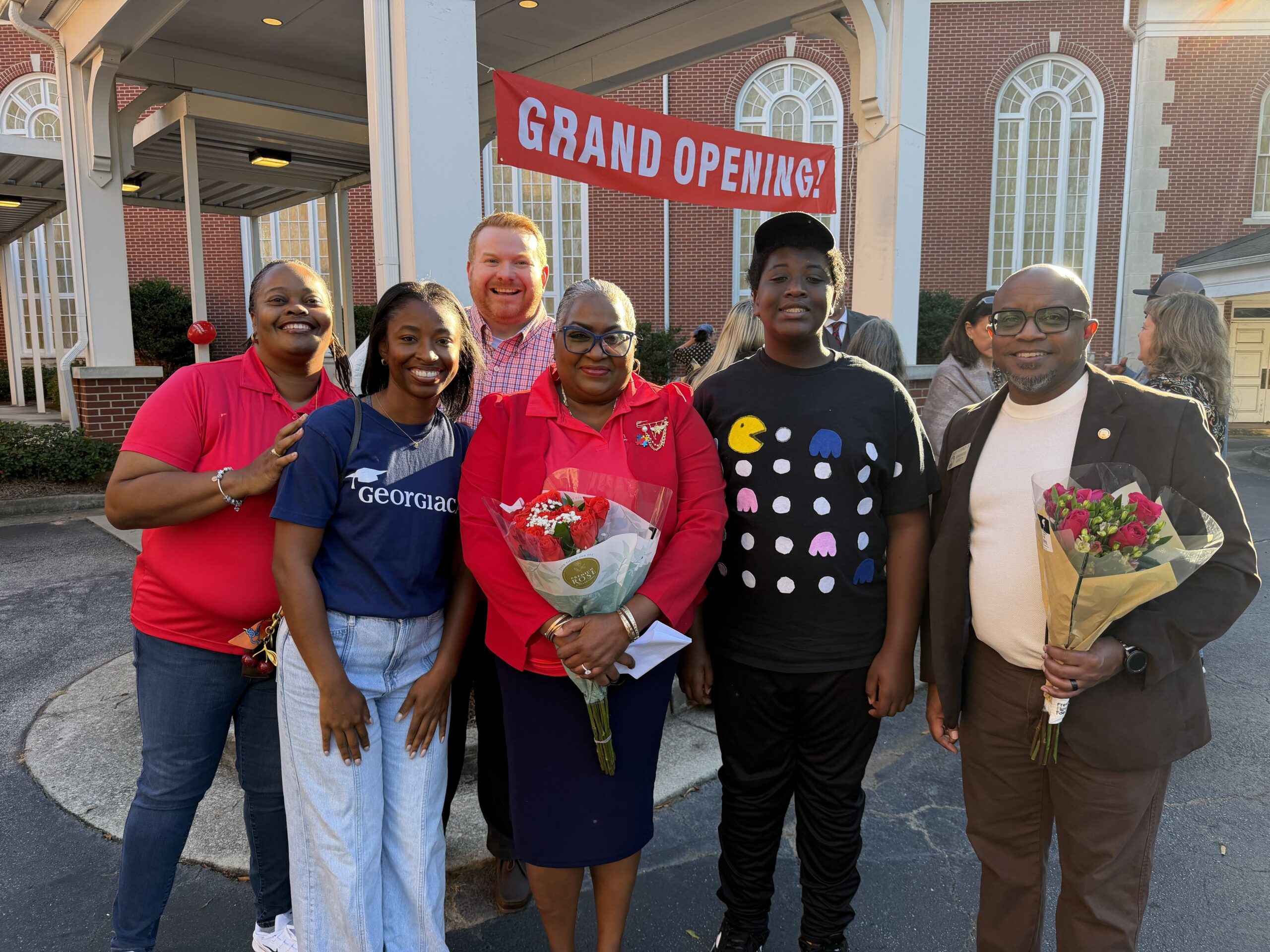
GeorgiaCAN parent advocates celebrated the launch of a new Tapestry Charter School in Clayton, one of the first new charter schools to open across the state after the team broke a logjam of new charters by changing the approval process two years ago. The efforts were spearheaded by GeorgiaCAN advocate Patricia Neely, who, after encountering Tapestry at a National School Choice Awareness Foundation and GeorgiaCAN event, fought for the school’s opening so that her own son could attend.
50CAN’s Liz Cohen was interviewed by NBC News on Maryland’s state assessment results, and also joined Holly Korbey’s The Bell Ringer for another in their series of podcasts reacting to the second season of Sold a Story.
On The New York Times’ The Daily podcast, journalist Sarah Mervosh dives into the growing enrollment challenges for schools.
Speaking of podcasts, NewMexicoKidsCAN is back with a new episode of New Mexico Rising, focused on Governor Lujan Grisham’s decision to opt into the federal scholarship tax credit.
DFER’s Jorge Elorza and Chad Aldeman, writing for The 74, offer advice on how to be an education governor for the nation’s 13 new governors-elect.
Brookings takes a snapshot of America’s school trends, and the picture isn’t pretty, with achievement gaps growing, achievement falling overall and only 32% of Americans being “somewhat satisfied” or “completely satisfied” with K-12 education.
A third of American children are no longer attending their assigned public school due to the growth of school choice policies, new research at EdWorkingPapers finds.
Overdeck Foundation’s Emma Banay and Jim Clark argue in The 74 that afterschool programs have broad benefits and could become even more popular with credit-for-learning policies that recognize learning across settings.
Urban Institute finds that federal changes on higher education student debt will affect up to a million undergraduate students.
Selected from over 1,500 entries, the winner of NPR’s Student Podcast Challenge is Cora Walsh, a middle school student from Long Island, New York. Her podcast, Dyslexia and MEE, traces her experience diagnosing and treating her dyslexia, primarily through the use of a reading tutor. “I’m kind of proud of myself that I overcame this hard, annoying thing,” Cora tells listeners.