
















Week 346
It is the start of week 346, the day before the 2026 elections, and we are thinking about how these ...

Jump to: Top Tasks | From the Field | Key Resources | Moments of Resilience
It is the start of week 346, the day before the 2026 elections, and we are thinking about how these are much more than “midterm” elections in states where governor’s seats are up for grabs.
It is common to think of our election cycles in terms of how they relate to US Presidential terms, with 2024 referred to as a “presidential election year” and 2026 as a “midterm election.” But 90% or more of what matters in education is decided in the states, so for many states this is much more consequential than a midterm. While obsessive pollwatchers focus on Nate Silver’s latest FLIPR election forecast on which party will control the US House and Senate, our teams have spent much of the year helping parents be informed participants in their local and state elections.
Writing for The 74, Kevin Mahnken explores what the results tomorrow might mean for the governor’s seats now up for grabs: “According to closely watched election forecasters like the Cook Political Report and the University of Virginia’s Center for Politics, Democratic candidates enjoy odds of 50/50 or better in five states currently controlled by GOP governors: Alaska, Georgia, Iowa, Nevada, and Ohio, home to a collective 4.4 million K–12 students. More than twice that number live in Texas and Florida, where polls suggest the party is at least in striking distance … In the unlikely event that Democrats prevail in all those races, most of them would still be constrained by Republican-dominated legislatures and, in several cases, budgetary shortfalls. Republicans themselves will also have a chance to overcome the partisan environment and seize Democrat-held seats in Kansas, Wisconsin, and elsewhere.”
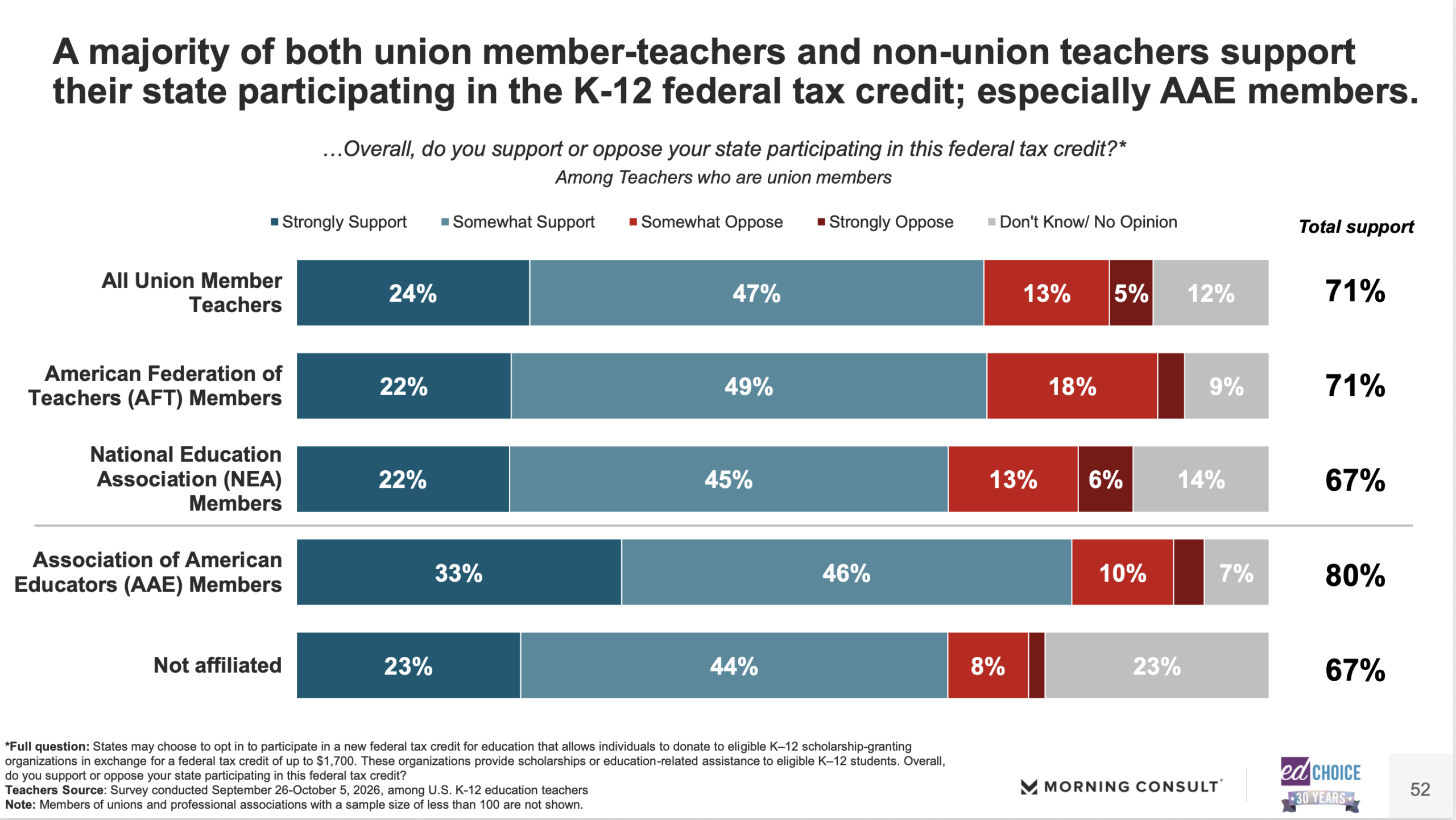
At the same time, the big education issues under debate don’t always map cleanly to political lines. Take the K-12 federal tax credit due to be rolled out in 2027. While both the NEA and AFT have opposed states’ participation in the program, a new survey by EdChoice and Morning Consult finds that two out of three NEA and AFT members support the program and very few oppose it. It’s a good reminder that no matter which way the political winds are blowing, elevating the voices of parents, students and teachers can help ensure we support the changes that will expand educational opportunities for all.
Last time in the New Reality Roundup, we checked in on Emily Hanford as she launched the new season of Sold a Story, focused on direct instruction, and noted New York Governor Kathy Hochul’s courage in becoming the second Democratic governor to opt-in to the federal scholarship tax credit. This week, we look at the trailing effects of the Baby Bust on charter and private school enrollment and discuss Bruno Manno’s call for CTE programs to focus on producing educational opportunities rather than simply growing enrollment.
Spread the word that declining enrollment affects schools of choice as well
We have been a bit obsessed with this topic in the Roundup and we are back writing about it because we think it’s that important.
We first warned of tough fiscal choices awaiting districts as student enrollment numbers dropped in April of 2023. By February of 2024, the Baby Bust had begun to affect large districts, with Los Angeles public schools and charter schools seeing significant enrollment declines. Four months later, we looked at Chicago, where one school was so underenrolled the per-pupil expenditures had risen to $93,000/student. Most recently, in spring of this year, we took stock of how declining enrollment coupled with “hold harmless” policies was creating a budget crisis in New York schools.
Now, we have one of the first portraits of how the Baby Bust is affecting smaller districts in Massachusetts, like Methuen and Lowell. “We definitely have too many schools for how many kids we have,” Marguerite Roza told the Wall Street Journal last week. The Journal describes the fallout: “The debates hit hard in Massachusetts, which has long prided itself on a top-tier public education. Near Methuen in the Merrimack Valley, Dracut Public Schools are considering closing an elementary school that has shrunk to 210 students from almost 300, eliminating busing for some grades and reducing full-day kindergarten to half. In North Andover, administrators closed an elementary school last year as a result of declining enrollment, redistributing about 200 students.”
Roza notes that nationwide enrollment has fallen 3.7% since 2017 with the decline expected to continue.
“Choice cannot be the scapegoat,” Cara Candal, vice president of policy at ExcelinEd, told The 74 earlier this month. “There just aren’t enough kids.” In fact, schools of choice are confronting the same challenges and making hard choices as a result. “When the Atlanta Public Schools announced last year that it would close 16 schools with declining enrollment, district buildings weren’t the only ones on the list. The plans to ‘repurpose’ facilities swept up two KIPP charters, Soul Primary and Soul Academy, which shared a campus in a predominantly Black community on the west side,” Linda Jacobson writes for The 74.
Advocates should be prepared that as schools compete for students, choice models will make for an easy and convenient political scapegoat. “The charter schools are siphoning kids off the public schools,” Lissette Fernandez, founder of Moms for Libros, a Miami public school advocacy group, told Jacobson.
What can be done that could be more productive? Right-size the number of districts to a state’s smaller student population. That’s exactly what New America is trying to make it easier for advocates and policymakers to do with their new School District Merger Lab where you can simulate different approaches to combining districts in your state.
Orient CTE programs to student outcomes
While enrollment might be shrinking everywhere, there’s one area that’s resisting the trend: career and technical education. As PPI‘s Bruno Manno notes, CTE programs have soared to over 8 million students with a growth rate of 10% year-over-year.
Manno cautions, however, that while growing enrollment is to be celebrated, the results of CTE programs have been rather mixed so far, with issues ranging from credentials not being aligned to workforce needs, emerging gender gaps in earnings and issues in providing participating students with internships and apprenticeships that would speed entry into the workforce.
Manno offers six recommendations for district officials and advocates that can improve CTE programs now:
One of the leaders on this working in the 50CAN network has been David Sun-Miyashiro, executive director of HawaiiKidsCAN, who has made program and workforce alignment central to his advocacy agenda over the past three years. Here is what he told us: “Given Hawaii’s extreme cost of living and continued out-migration of young talent, the stakes are incredibly high for students who don’t have the skills and connections they need to access living wage careers in the state. That is why HawaiiKidsCAN has helped pass legislation to improve CTE programs by promoting valuable industry recognized credentials and to expand data sharing and reporting systems to better track student outcomes. These recommendations provide a great blueprint for what can come next.”
EdWeek profiled NewMexicoKidsCAN Executive Director Amanda Aragon on the package of literacy reforms she successfully advocated for last year. Amanda spoke on the disconnect between student outcomes on the state assessment and the high percentage of parents who believe their child is on grade level, as measured by the Educational Opportunity Survey. “Parents who think that their kid is on grade level are going to interact with the school system differently than they would if they knew their child was struggling,” Amanda shared.

TennesseeCAN Action Fund held a gathering to celebrate the state’s major wins on education policy over the last year, featuring gubernatorial candidate U.S. Senator Marsha Blackburn and legislators from across the state, including awardees Senator Bo Watson and Representative Ryan Williams.
In Connecticut, ConnCAN Executive Director Steven Hernandez discussed the federal scholarship tax credit with the CT Mirror, where he noted how useful the funds could be for public school students looking to access a tutor or supplemental programming. “We’ve taken the position of ‘Leave no dollar behind,’” Steven said.
Liz Cohen joined up again with Holly Korbey and Chad Aldeman for another discussion on The Bell Ringer podcast on the second season of Sold a Story. This time the trio discussed the second and third episodes, Emily Hanford’s ability to bring the public into the classroom, the importance of educator curiosity and a brief debate on whether Chad or Liz is a bigger education policy nerd.
OhioKidsCAN’s Amber Keener sat down with Fordham’s Mike Petrilli to discuss the upcoming Ohio elections and what might happen should Democrat Amy Acton flip the governorship: “The reason I believe so strongly in bipartisan education reform is that no party has a monopoly on student- and family-centered policy. We’ve seen this in Ohio and we’ve seen this across the country in all of the states that are part of the 50CAN network. Under an Acton governorship, should that be the final result of the election, I believe there’s a pathway to improve both math and chronic absenteeism, while some other policy areas may move to the back burner. As advocates, we need to be committed to growing educational opportunities for kids regardless of the politician, or political party, in power.”
The 74 has the story of EDGE Microschool in Missouri, one of the nation’s first public microschools, that was created by teachers and administrators within a larger high school.
Fordham dives into the latest state in the Southern Surge that’s showing a literacy turnaround: Alabama.
Given the challenging job market awaiting recent college graduates, Urban Institute’s new brief offers recommendations for colleges and universities, including building students’ workplace readiness skills and non-degree credentials.
One way community colleges are mitigating the Baby Bust and enrollment decreases: enrolling older adults. Chalkbeat reports on a community college in Colorado that’s gained hundreds of older adult learners.
Students in Hamilton County, TN learn to play marbles after a group reading exercise at the Soddy-Daisy Community Library. As part of the Chattanooga 2.0 plan, supplemental literacy work is being done by libraries, community organizations and afterschool programs in a new pilot that the Afterschool Alliance calls the “gold standard” in afterschool literacy programming, and one they believe is ready to be scaled to other districts across the country.