















Week 344
It is week 344 and we are asking ourselves: what’s the evidence that education policy reforms actu...

Jump to: Top Tasks | From the Field | Key Resources | Moments of Resilience
It is week 338 and we are digging into all the data from the big new PISA release.
The headline: American students’ reading scores have dropped to near a 25-year low, with a 14-point decline in scores since 2022 that dropped our international ranking four spots, from 9th in the world to 13th.
Here are the details: Earlier this morning, the Organisation for Economic Co-operation and Development (OECD) released the latest results from the Programme for International Student Assessment (PISA), a worldwide assessment of how well 15-year-old students apply their mathematics, science and reading knowledge to real-world problems. Here are the US results across the subjects tested:
Today’s results are from the tests administered in 2025, which involved more than 760,000 students across 91 countries. You can access all the data here.
And here are the key takeaways from the first two major US news outlets out today with stories:
The New York Times: “The reading scores of American 15-year-olds have fallen sharply since 2022 and are near their lowest point in 25 years … Just 8 percent of American teenagers scored at the highest levels in math on the PISA, compared with 37 percent in Singapore, 23 percent in Korea and 22 percent in Japan.”
Chalkbeat: “U.S. PISA scores in math and reading are at or near their lowest level” but “Tuesday’s international release suggests student achievement is not something that only the U.S. is struggling with … Whatever factors are driving down scores here — and academics aren’t sure what those are — might also be affecting children elsewhere.”
We will be surfacing and sharing the best PISA analysis on social media throughout the day, so please check in on our X, LinkedIn and Instagram accounts for more.
Last time in The New Reality Roundup, we looked at AEI‘s recommendations to improve charter regulations and examined concerning patterns in the early elementary achievement gap. This week, we look at OhioKidsCAN‘s efforts to cultivate legislative champions and take note of some encouraging career pathways models emerging across the country.
Follow OhioKidsCAN’s lead in building champions from those already in office
Two weeks ago, OhioKidsCAN Executive Director Amber Keener brought together a bipartisan gathering of state representatives, senators, prospective candidates and staffers to the Athletic Club of Columbus, for an event she dubbed Education 101.
“It’s always good to be a convener. I guess you could call it a coming out party,” Amber laughs, “But this was always more than announcing our advocacy presence in the Buckeye State. I’ve believed for a long time that there are a great number of education champions currently serving in office–they just don’t know they’re education champions yet. That’s what I’m trying to change with Education 101.”
In pulling together the invite list, Amber looked to legislators who didn’t have education in their top three priority policy areas but who had a track record of smart, constituent-oriented service. Working alongside coalition partners–Chad Aldis from Fordham Ohio, Eric Frank with School Choice Ohio, Cassandra Palsgrove from Ohio Excels and Devin Babcock from ExcelinEd–Amber held discussions on 4 topics:
“We were really happy with the success of our first major event in the state of Ohio, especially the broad support, including legislators representing both parties and a range of committees in the statehouse. The first step to building champions for kids is helping our elected officials understand the intricacies and nuances of the system, what students need at this moment, and the policies here in Ohio and across the country that can work to meet those needs,” Amber reflected.
There has been a huge surge in interest in career and technical education since the pandemic but what will it take to make lasting change? At The 74, FutureEd fellow Anne Kim penned a column arguing that what is needed to move career pathways from the margins of the education system to the very center is much better delivery of services and curriculum design.
Kim lays out the current challenges: “Counselor shortages remain persistently severe, while career navigation is often a back-burner priority … Consequently, too many young people are unaware of the careers they could pursue, the availability of jobs locally, and the skills required. A 2024 survey found that 66% of young adults ages 16 to 24 ‘do not know exactly what career they want to pursue.’”
Kim points to California’s Cajon Valley Union School District as one promising model of for how to weave career exploration throughout the school day, culminating in high school seniors spending nearly half of their time at jobs or internships.
Kim also puts a spotlight on the role nonprofit partners can play, from Jobs for the Future to the Strada Foundation to Chicago’s OneGoal. In each case, these programs are showing direct results as well as more indirect ones–the student fellows selected for OneGoal’s career coaching program each year graduated high school at a rate 15% higher than their peers.
Questions remain for scaling these programs to deliver career opportunities to more students, but the need to expand students’ access to real world experiences has never been greater. “That more than 1 in 10 young people, ages 16 to 24, are disconnected from work and school should be an alarming wake-up call to the failures to provide our kids with a clear path,” says Liz Cohen. “Anne Kim is pointing to smart solutions here, both human and technology-based, but we’re going to need the will and public investments to spread them further.
50CAN’s National Voices Fellows have been active this summer, with fellow Marisa Mission talking AI and schools on the Edtech Insiders podcast and fellow Thibaut Delloue writing on charter school hiring best practices for Education Next.
The HawaiiKidsCAN team wrapped up their summer cohort of Hawaii Tutoring+, which provided over 370 hours of free tutoring to 125 student participants. One student offered a rave review on the final survey: “I am very glad I was given such a nice and helpful tutor and I have told my mom I hope to do this program again. Hopefully, I’ll have her as my teacher again so whoever is her boss, give her a raise because she is a nice, helpful tutor who helped me a lot this past two months and I hope to have her as my tutor next summer. 5 stars, good job!!”
ConnCAN’s Luis Ortiz joined with other members of PolicyLink’s Connecticut cohort in Washington DC, part of the team’s long-running experiment to build support for education reform in progressive spaces.
In The Hill, Patrick Wolf warns that chronic absenteeism was worsening the learning crisis and increasing students’ risk of dropping out.
At Fordham, Daniel Willingham argues that students should use AI only for tasks they already know how to do well.
A fresh set of data from the National Federation of State High School Associations reveals that high school sports participation has strongly rebounded from the drop during the pandemic.
A new study published at EdWorkingPapers finds that students taking the MAP test on days with temperatures in the 90s scored more than 1.5 percentiles lower in math than on days in the 70s.
Urban Institute offers a four-part classification system for youth apprenticeship programs, finding that youth-focused models reached more young women and rural students and spanned more career fields than adult programs.
Strada Education Foundation opened registration for a September 30 webinar featuring new research on work-based learning and lessons from North Carolina leaders who are strengthening career pathways.
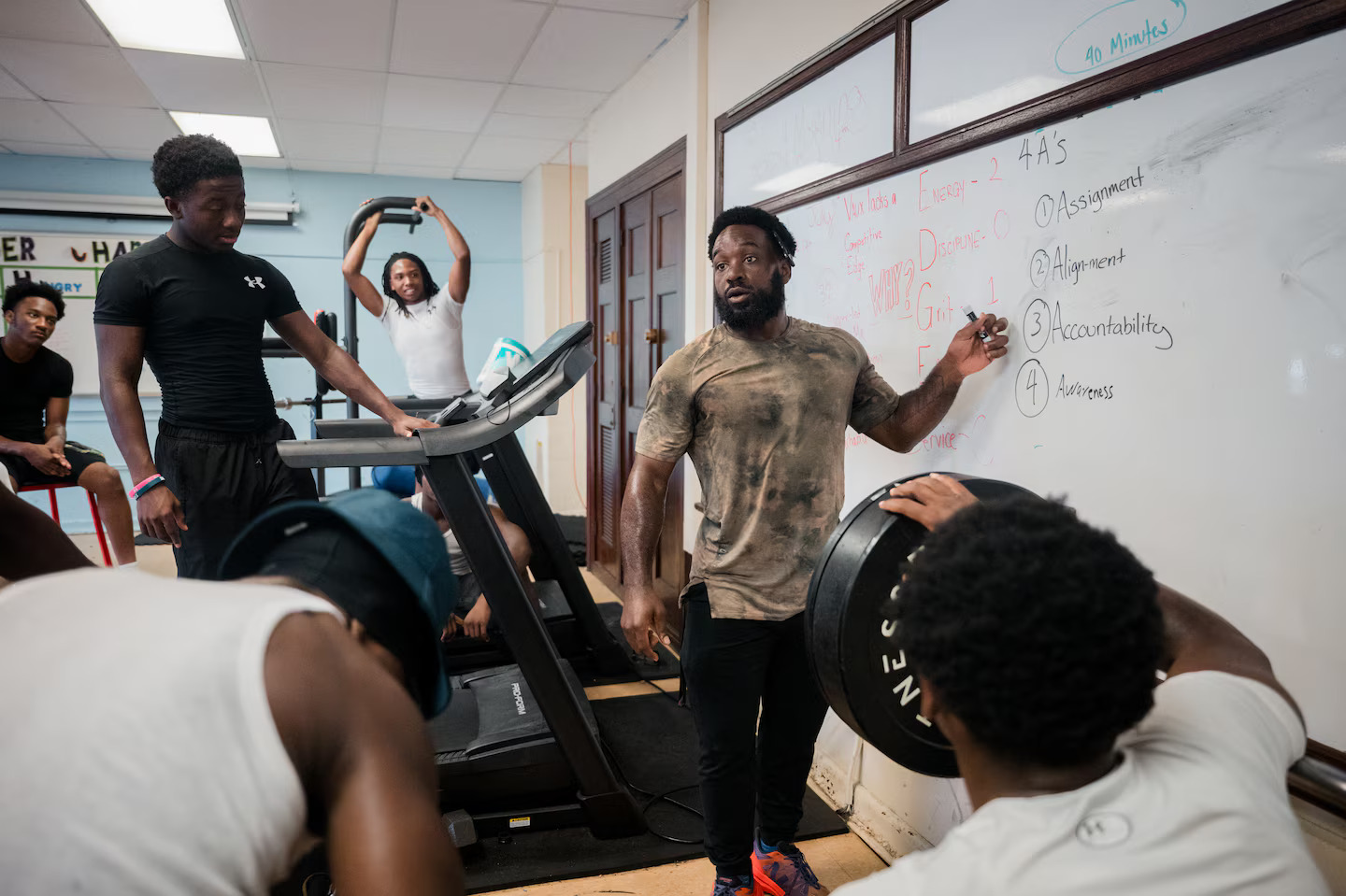
This week marks the opening of the NFL football season, but in Philadelphia, Chalkbeat profiles the coaches of several high school football programs across the city, finding leaders like Coach Jordan Holbert who is working to instill in his players a set of core values and emotional management given violence in their communities and lives. One of the many challenges during the Covid-era school closures was the loss of community experienced by student athletes when their sports programs came to an abrupt stop. Slowly, schools are succeeding in reconnecting with students and using sports like football to help them with their journey through high school. “For a generation of children cooped up in pandemic lockdown, the sport offers a chance to bond with new friends before the school year starts. At a time of loneliness and fragmentation, football promises community,” Albert Samaha notes in the Washington Post.