















Week 344
It is week 344 and we are asking ourselves: what’s the evidence that education policy reforms actu...

Jump to: Top Tasks | From the Field | Key Resources | Moments of Resilience
It is week 336 of our new reality and as students across the country prepare to embark on another school year, we are thinking about how the generation that endured so much lost learning when schools were closed is now facing another enormous headwind: learning lost from an over-reliance on AI.
“Students and schoolchildren are increasingly using artificial intelligence. A survey last year by Chegg, an ed-tech firm, found that 80% of rich-world undergraduates used it in their studies,” reports The Economist. Now a big new study tracking 26,000 students aged 12-18 in China is starting to unpack the impact of AI adoption on learning and what it found is troubling.
“After six months, pupils using AI saw their average homework score rise by 18% across all subjects. The time they took to complete each assignment fell from an average of 64 minutes to 45,” The Economist notes. “But come exam time, the same students scored 20% below their classmates who had not called on AI’s help. Homework scores once predicted exam performance; now those who score highest are, perversely, more likely to do worse in exams.”
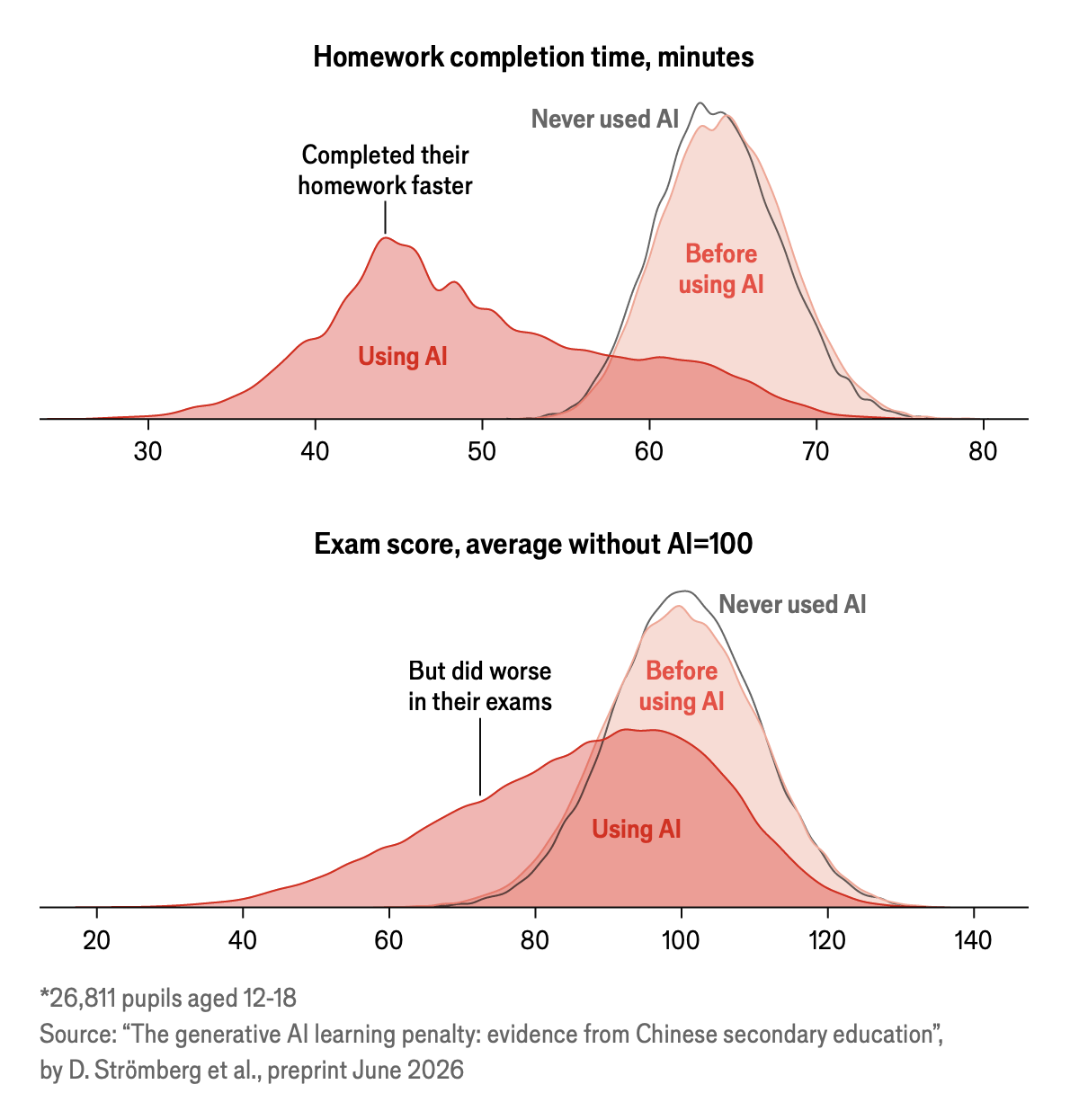
Put simply: When students use AI to skip over the productive struggle of long hours of homework, they end up skipping over the learning itself. The Economist concludes: “Students must resist the temptation to reach for an AI-generated answer before thinking things through for themselves.”
How do we stop this over-reliance on AI from undermining a whole generation of students? Parents need to do more to educate their children about the harmful effects of AI on learning and schools need to rethink how they set grades to put the focus on a true demonstration of knowledge. That will require a much greater use of in-person, proctored tests and writing assignments when determining grades.
Last time in the New Reality Roundup, we looked at new polling from Data Science 4 Everyone and Mathematica on growing parental demand for data literacy and considered Rick Hess’ analysis of the growing techlash. This week, we look into what’s next for charters in a more competitive landscape and examine new evidence on the stubbornness of the achievement gap in early elementary.
Rethink charter regulations for a more competitive future
For years charter schools owned the lane of offering free choice to parents dissatisfied with their district school option. After a series of sweeping school choice victories over the past five years, that is changing. Now the question is: how will charters respond?
A new research report from AEI aims to answer that question by surveying 285 charter school leaders in Arizona, Florida, and Utah.
Arizona charter leaders have the most experience working alongside ESAs. For the surveyed school leaders there, nearly half (48%) reported having students withdraw to utilize ESA funds on private school tuition or homeschooling. Moreover, 58% of Arizona leaders predicted the accounts would continue to decrease their enrollment over the coming years. In Florida and Utah, 28% and 32% of charter leaders were concerned about scholarships decreasing their enrollment in the future.
While authors Ian Kingsbury and David Marshall note that charter schools still have a funding advantage over private schools using ESAs, they also heard from many respondents that leading a charter comes with higher compliance costs, mandates and expensive facilities that potentially make an ESA-funded private or microschool more appealing. Perhaps not surprisingly, between 25% (Utah) and 38% (Arizona) of respondents said the ESA program made them more likely to consider opening a private school or microschool.
Kingsbury and Marshall offer four recommendations for policy advocates looking to make charter schools more competitive, ranging from long-held goals of charter advocates like reducing the most burdensome regulations to embracing hybrid approaches that give students access to both charter course offerings alongside ESAs.
No matter what reforms charter advocates pursue, it’s clear that now is the time to consider these changes while the ESA programs are still rolling out.
To close the achievement gap, intervene much earlier
NWEA, the research and assessment group whose assessments are used in over 35,000 schools, released a new, in-depth report with a striking finding: Kindergarten diagnostic test scores are highly predictive of reading and math proficiency at the end of third grade, with early grade schooling having little impact on students reaching the bar of proficiency:
In other words, in these early grades, time is working against students who come in behind their peers.
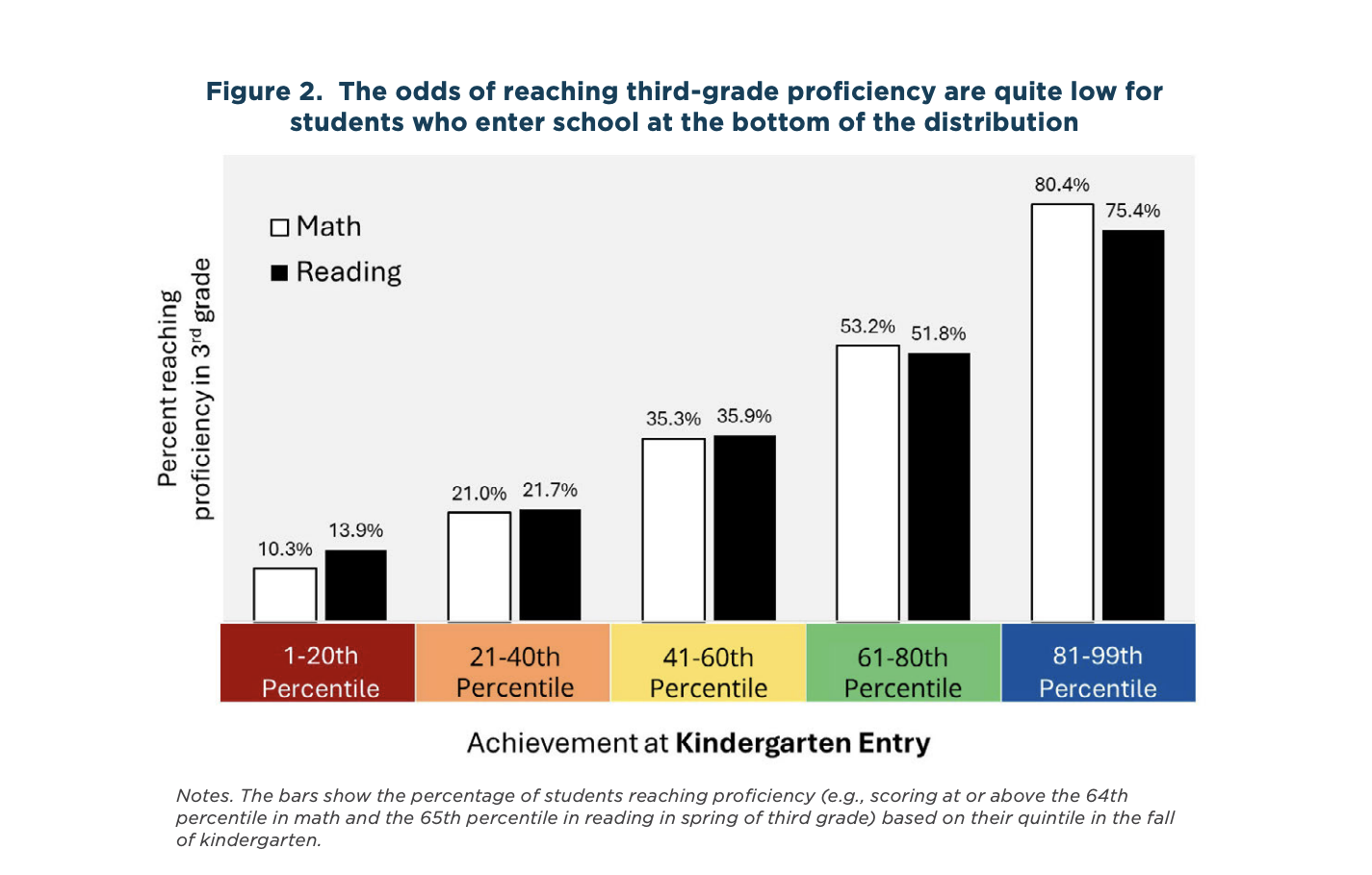
“Students who entered school with the lowest achievement levels faced particularly long odds of reaching proficiency, while students who entered school with stronger skills were substantially more likely to meet that benchmark,” the authors conclude. This is precisely the problem that the education reform movement was started to tackle and this report is a good reminder of how much more work is needed to be done.
What needs to be done differently? The authors stress the importance of early screeners to identify the students most in need of interventions. That’s a point of view strongly shared by the Executive Directors across the 50CAN network, who have made early screeners a critical priority in both literacy and math. To date, across the network, we’ve ensured screeners for early elementary students in New Jersey, Louisiana, Tennessee, Georgia, Delaware, Connecticut, Colorado, New Mexico, Ohio, and most recently in Hawaii, which emerged from this session with a new literacy law that establishes screeners, the first bill of its kind passed in Hawaii in more than two generations.
“We all know the importance of reading by third grade–haven’t we all heard this a million times by now? The problem we had is that the first time we assess is at the end of third grade,” Michael O’Sullivan, the Executive Director of GeorgiaCAN who passed a literacy screener back in 2023, shares. “Our first look is already too late. Early screeners are the obvious solution, not just for identifying the students that are falling behind but also for supporting their teachers. That’s why we made the move when we did.”
Sunlight will help to ensure that parents, educators and stakeholders understand the immediacy of the problem, but it won’t solve the problem on its own. That’s why so many leaders in the 50CAN network are working to couple this increased transparency with a big expansion of the programs with a track record of success, including curriculum grounded in the science of reading and high-dosage tutoring.
The wait is over! After a year’s hiatus, the NewMexicoKidsCAN team is back with a new season of the New Mexico Rising podcast. In the episode, Executive Director Amanda Aragon and Advocacy Manager Dominica Chavez offer candid reflections on what it has meant for the state to have been at the bottom of national achievement rankings for a decade, along with early signs of hope for the future.
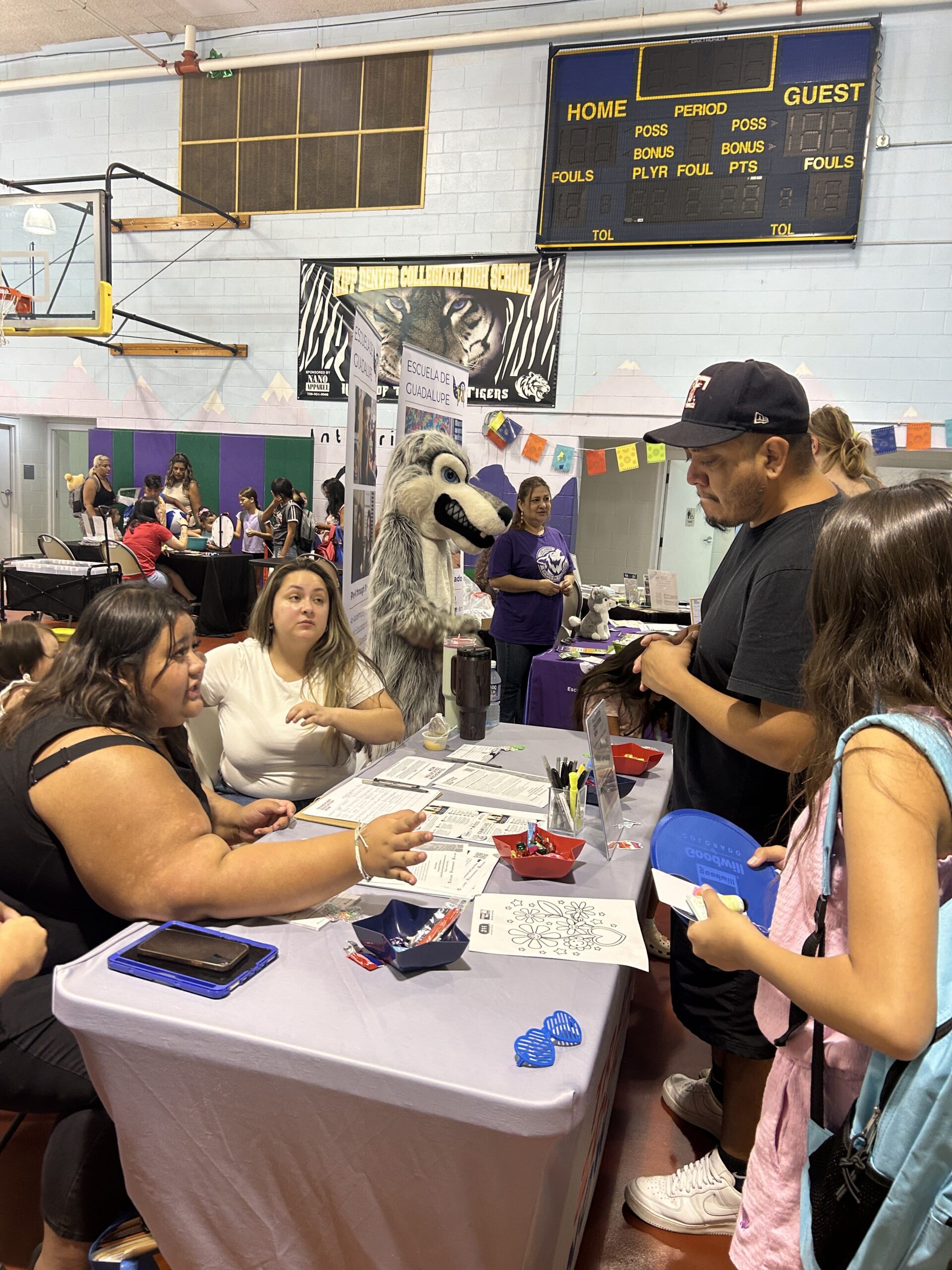
With the school year fast approaching in Colorado, the Transform Education Now team has been putting in hours and miles to meet with as many parents as possible, providing back-to-school resources and closing the information gap on the federal education tax credit after Governor Polis opted in. “There’s a high level of engagement from parents in the weeks leading up to the school year, and we try to never let that go to waste,” says Executive Director Nicholas Hernandez.
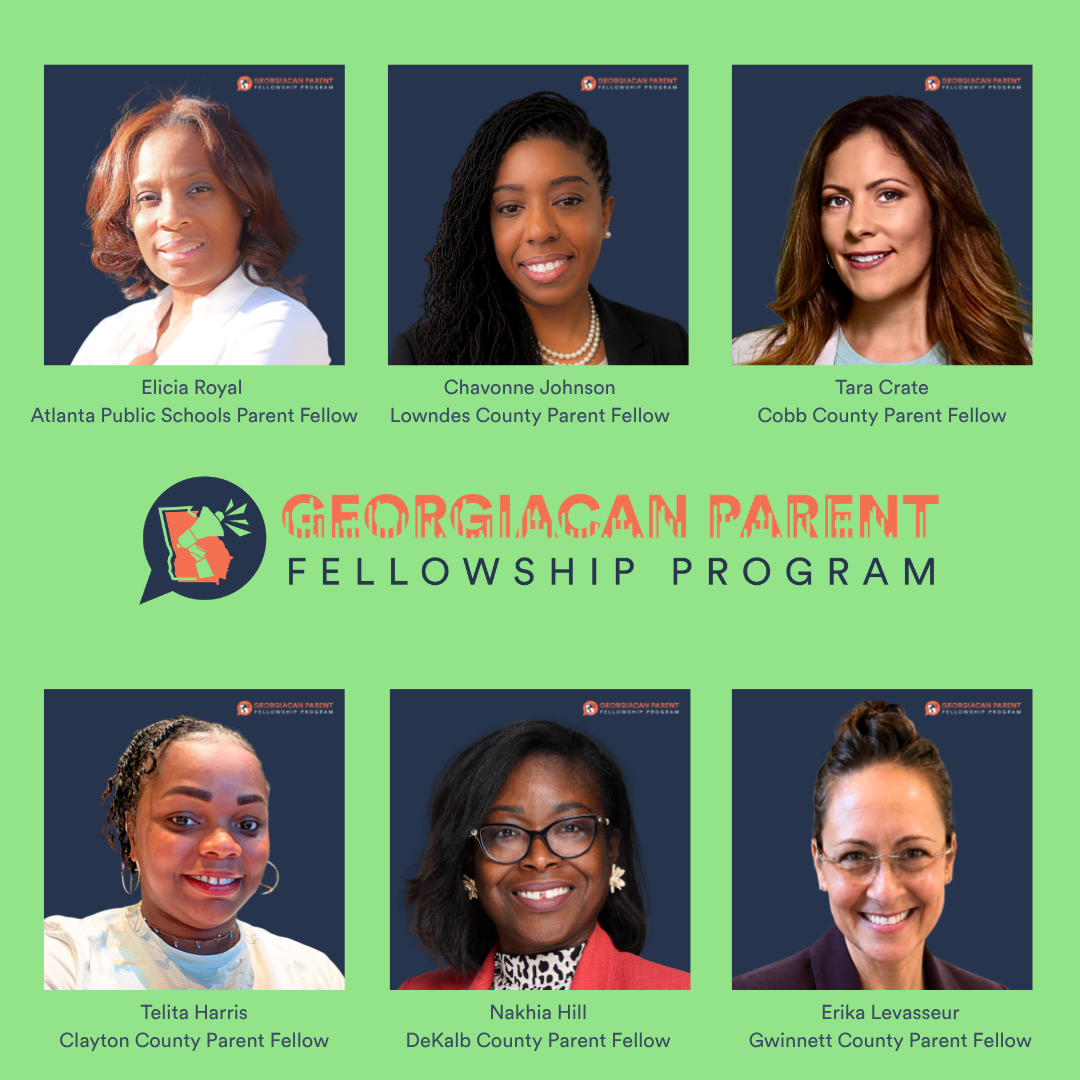
After a selection process that involved more candidates than ever before, the GeorgiaCAN team announced the next cohort of the GeorgiaCAN Parent Fellowship Program. Previous parent fellows have successfully opened new charter schools, spearheaded bills through the legislative process and, as recently as this past year, have been elected to public office. Keep your eye out for news on these rising stars!
Fordham checks in on a 2022 Missouri law enacted to close the funding gap between neighborhood public schools and charters and finds that while charters received a funding windfall, there hasn’t been a meaningful reduction in the funding disparity between school types.
Should the science of reading and the science of math be joined by the science of writing? EdWeek takes a look at some promising pilots in New Hampshire and Arizona.
A week from today, Brookings hosts a webinar on developing intellectual humility in middle and high school students. RSVPs are open now.
A new study published by EdWorkingPapers presents the results of the largest and longest experimental evaluation of an AI tutoring program to date, finding that the gains from Khanmigo were similar to students who used the Khan Academy platform without AI assistance: “One explanation is that students used the tutor infrequently and, when they did, rarely engaged it in substantive mathematical dialogue.”
America now has over 700,000 apprenticeships, a 77% increase in participation over the previous decade, and Urban Institute provides advice on continued scaling without losing quality.
New America, in collaboration with the Strada Education Foundation, identified three improvements for teacher degree apprenticeship programs from leadership to funding sustainability.
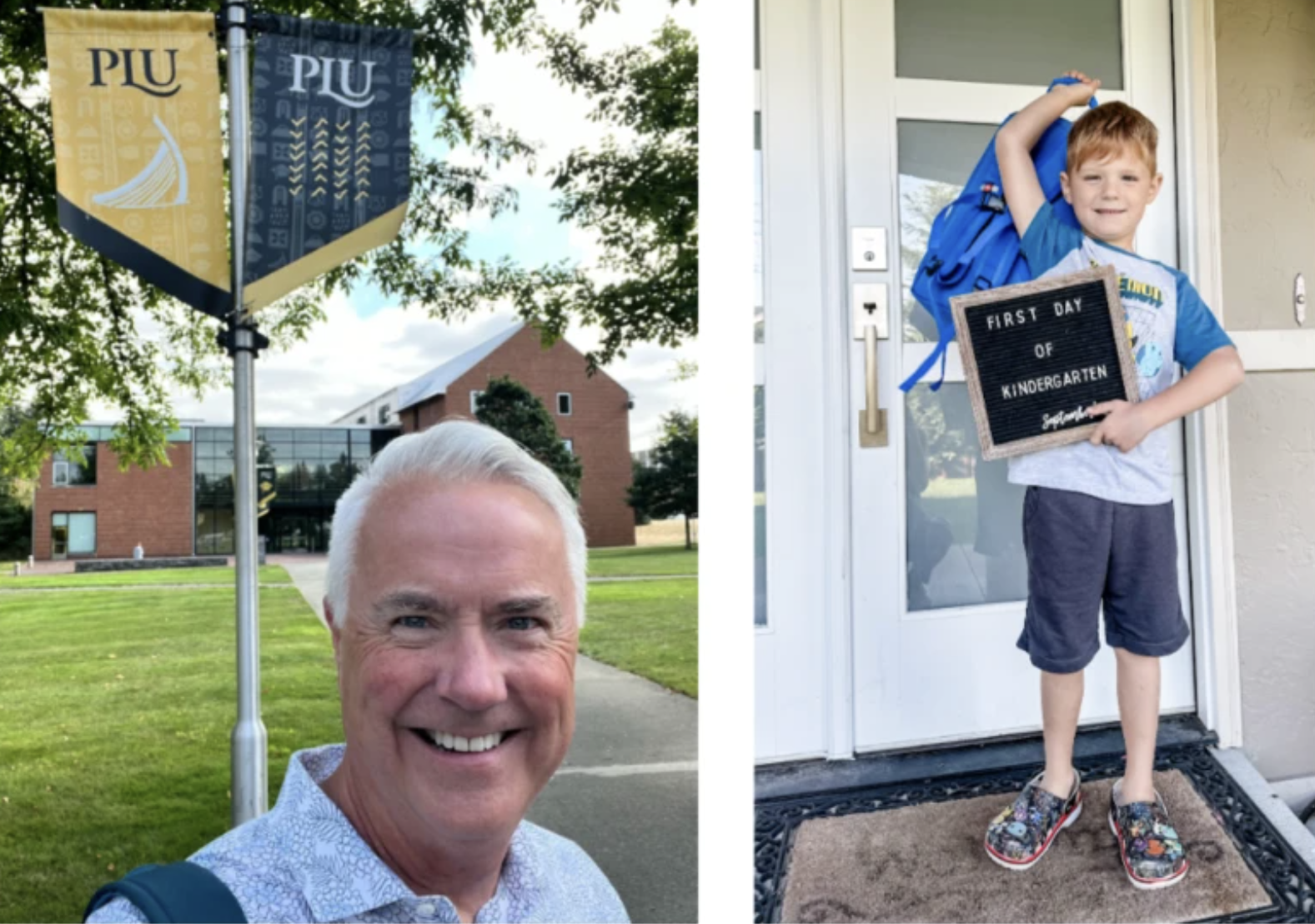
It’s Back to School season, and we can think of no better way to mark the occasion than by sharing EdWeek’s story of 62-year-old Michael Nelson, who headed back to school last week to pursue a doctorate on the same day that his five-year-old grandson was heading to his first day of Kindergarten. The story is a reminder that embarking on a year of curiosity, exploration and learning comes with nerves and excitement at any age.