















Week 340
It's week 340 and we are thinking about the role of standards in education and what happens when we ...

Jump to: Top Tasks | From the Field | Key Resources | Moments of Resilience
It is week 332 and we are thinking about experimentation and evidence in education reform. Alpha School is a network of AI-powered, private schools that has captured the attention of wealthy Americans and technologists with a bold claim: “Your kids can accomplish twice as much if they’re not sitting in a one-size-fits-all classroom for 6 hours.” Instead, it uses a “2-Hour Learning” model that leverages adaptive software and AI tutors. Alpha School has gained an enormous amount of media attention in a short period of time. The founders’ ambition is to spread the model around the world and ultimately serve one billion students, starting with an aggressive expansion in the United States. But do their bold claims deserve a closer look?
“I want badly for this to be true,” Robert Pondiscio writes in a new article on Substack. “American education desperately needs genuine breakthroughs. If you’ve discovered a fundamentally better way to educate children, I want researchers to validate it, educators to emulate it, and policymakers to encourage more of it. I want you to be wildly successful, even rich. But rooting for you is precisely why I’m writing: we can’t just take your word for it.”
“Your signature claim, that students learn ‘2.6 times faster’ than expected, is now central to your public identity,” Pondiscio continues. “Yet researchers still cannot independently reconstruct how that figure was derived or test alternative explanations. How is expected growth defined? Who are the students? Does the rapid progress come from Alpha’s program or from its appeal to already strong, motivated families who can afford $40k+ tuition?”
The article gained a lot of attention on social media last week. Here is what John Arnold, a leader in evidence-based philanthropy, had to say: “I strongly second this call from Robert Pondiscio. If Alpha works as well as claimed, open up and let ed researchers study it and policymakers learn from it … There is great promise in the intersection of tech and broad-scale learning. But extraordinary claims also need external validation.”
In response to Arnold’s post, Alpha School’s principal Joe Liemandt wrote: “My reading of history is that our traditional education system is based less on ‘verified facts’ and more on ‘vibes.’ … I’m not against verification. But I constantly tell our team that publishing a study showing our approach works will likely have the same impact as Project Follow Through in the 1970s or the MIT charter-school study published just before Massachusetts stopped expanding charters.” In other words: don’t count on any independent studies any time soon and in the meantime it’s full speed ahead.
For those of us that have been in this work for a while, we have seen our fair share of new ideas that drove a hype cycle. Experimentation is good because it’s clear we don’t have it all figured out. At 50CAN, one of our four workstreams is our Build work, which supports entrepreneurs in creating new proof points of what’s possible in education. But people who support experiments also have a responsibility to insist on evidence of what works, grounded in independent evaluation. There are costs to scaling new ideas before they are ready. If Alpha School does eventually agree to independent research, we will make sure to highlight the results here in the Roundup. If it doesn’t, we will aim to put a spotlight on those innovations that are grounded in clear evidence of their impact on kids.
Last time in the New Reality Roundup, we looked at Nat Malkus’ suggestions to districts dealing with chronic absenteeism and examined recent reporting on the fallacies of California’s test-blind university admissions. This week, a new report from Brookings shatters a commonly held myth and Liz Cohen calls for a temporary pause on technology in the classroom.
Few ideas in education are as fixed in the minds of both policymakers and the public as the idea the inequalities in outcomes between low-income communities and high-income communities are the result of low-income districts receiving significantly less funding per pupil.
There’s just one problem with this argument: new research from The Brookings Institute suggests that it’s not true.
In their report, “School Spending Equity since 1976,” authors Sarah Reber, Beyond Deng, and Gabriela Goodman look across years of public school spending data and find that low-income and predominantly non-white school districts have actually spent more per pupil than their higher-income and whiter counterparts over the past 50 years. This additional spending in low-income districts has increased over that same time period.
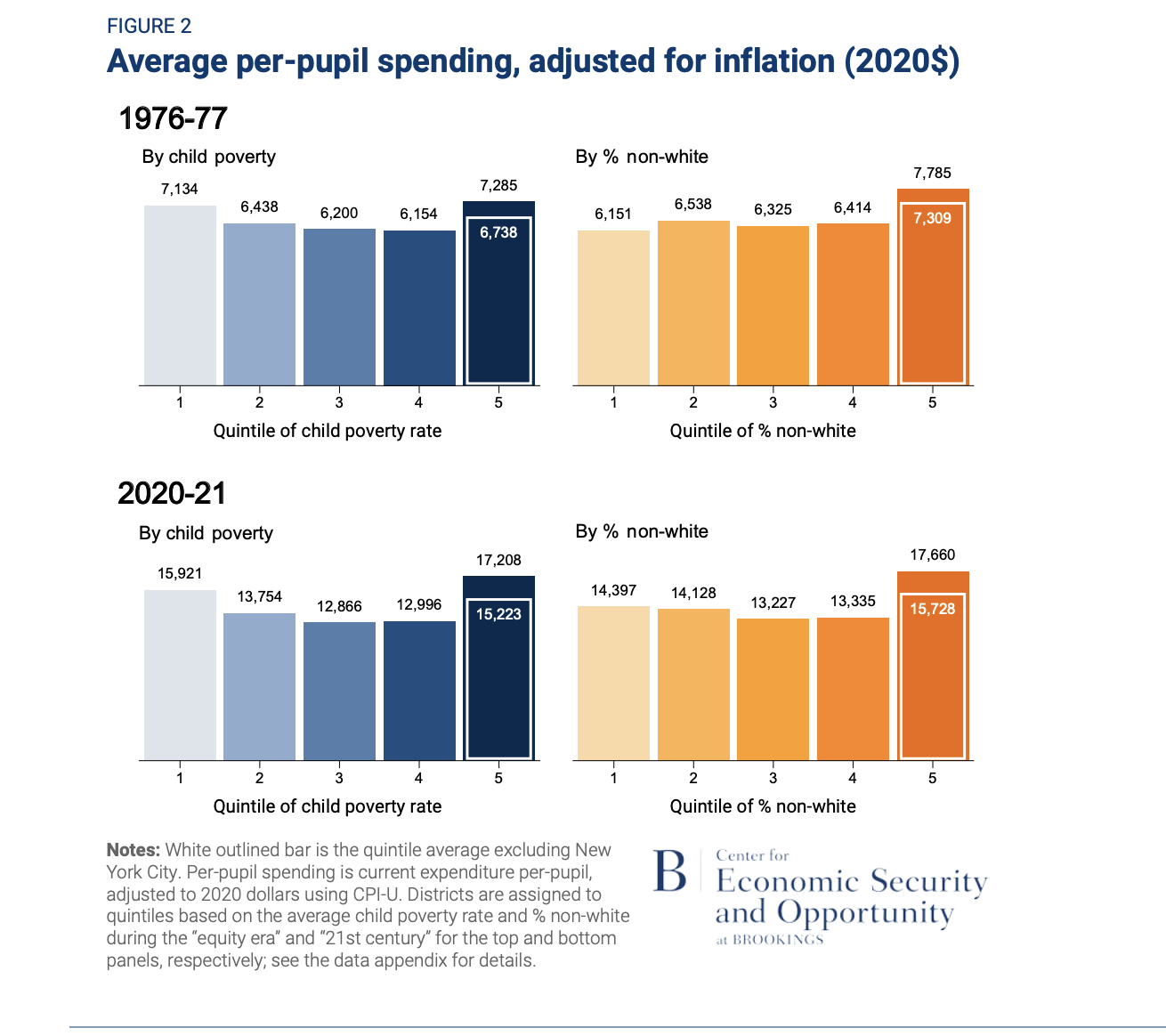
What should we take away from these facts? First, if we believe that the students who are the furthest behind need more money than the average, we need to make that case directly. Second, we need a new focus on fiscal transparency that takes a hard look at how districts are spending their money to ensure it’s well spent.
That’s where the example of Tennessee comes in. TennesseeCAN Executive Director Chelsea Crawford won on a major fiscal transparency bill earlier this year that requires annual reporting on all school- and district-level expenditures. “The money that we’ve spent in Tennessee has led to higher outcomes than it has in other states, because our number one priority has always been evaluating the impact on students, rather than just dumping money into the system. The fiscal transparency bill that we passed is designed to get this information directly to parents because without the transparency, taxpayers will continue to believe a myth.
“As of July 2026, Utah, Tennessee and Iowa had K-5 screen-time limits or bans for K-5, and states like Virginia and Maine are beginning to study or develop similar policies. Yet transforming technology use inside schools and classrooms is so difficult that an intentional break may be the only way to truly adopt a better approach,” writes Liz Cohen at The 74, as she wades into the conversation over technology in schools. “Bring on the bans.”
The goal of a temporary ban is to give districts and educators time to develop a vision and plan for how technology can be used in responsible and limited ways in the classroom, while also meeting the demands of increasingly angry parents frustrated by 1:1 student to laptop ratios and extensive, independent screen time.
Signs of the rising backlash have emerged in the media, including in The Wall Street Journal’s story of how YouTube took over the American classroom includes an interview with a student who watched 13,000 hours of YouTube in class. In April, the New York Times reported on the rising backlash to tech in classrooms.
“When the ban is eventually lifted,” Liz argues, “School officials could reintroduce technology slowly, purposefully, with feedback gathered along the way and with clear metrics to determine whether students are reaching desired results.”
At Education Next, 50CAN’s Liz Cohen reviews Ted Dintersmith’s new book Aftermath, finding the suggestion to get rid of calculus “misguided.”
GeorgiaCAN is hosting two conversations with the community later this month, including a dialogue on math education in the state and a back to school parent panel.
HawaiiKidsCAN Advocacy Director Erica Nakanishi-Stanis was interviewed by Hawaii Public Radio on the team’s win to expand the Hawaii Promise Scholarships program.
50CAN Math and Data Science Fellows Jack Powers and Arty Smith met together in Nashville to further their work on reimagining K-12 math pathways.
Fordham shares a study of New York’s small schools of choice (SSC), school models that were established by Mayor Michael Bloomberg in the early 2000s, finding a 76% four-year high school graduation rate in SSC schools compared to 68% for non-SSC students.
Teach For America CEO Aneesh Sohoni sits down with Rick Hess at Education Next for a candid discussion of TFA’s journey so far and what he’s hearing from recent college graduates.
A new report from Urban Institute highlights the key questions lawmakers must consider as the economy transitions to the Age of AI, from job-employee matchmaking to support for displaced workers.
AI models are changing faster than randomized control trials can be completed, creating a real problem for researchers that Brookings explores.
At The 74, Chad Aldeman offers readers five insights to understand how money moves in the American education system, from state disparities to worker benefits.
A report from the Center for American Progress finds that due to inflation, there is a $230 million federal funding gap for career and technical education programs.
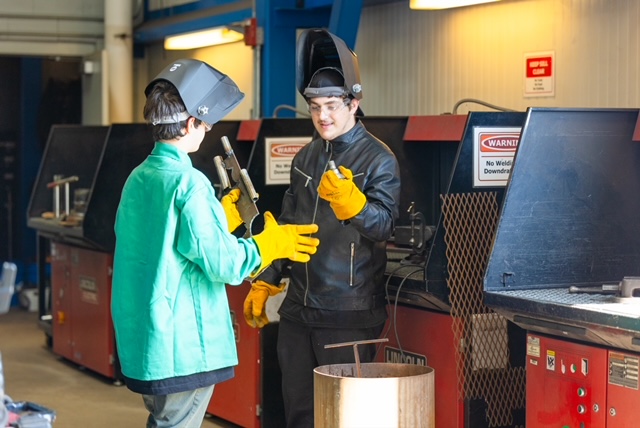
In Manchester, New Hampshire, the local community college has partnered with the Fabricators and Manufacturers Association to launch the SparkForce Summer Camps. The camps teach middle and high school students robotics and welding, and the students also meet with local business leaders who run hands-on projects applying the new skills.