
















Week 316
It is week 316 and we are thinking about the importance of transparency in our goal of making eviden...

Jump to: Top Tasks | From the Field | Key Resources | Moments of Resilience
It is week 308 of our new reality and in states across the country legislative sessions are open for business.
As we shared at the close of 2025, our state campaigns this year have made literacy and math central to their work. And one month in, we’re already beginning to see progress. In New Mexico, both a math bill and literacy package have advanced through committee on unanimous votes. In Connecticut, the Governor made commitments to both math and literacy that are aligned to ConnCAN’s 2026 priorities. In the Volunteer State, TennesseeCAN and Excel in Ed are collaborating on a robust set of math reforms for both elementary and high school students. And in Georgia, the Speaker of the House announced bipartisan support for legislation that would bring highly-trained literacy coaches into every school in the state.
One of our goals for this Roundup is to uplift the work of states so we can all learn from the progress we are making. So we’ll be sure to keep you updated on progress toward these goals–and the dozens of other goals for 2026–throughout the legislative season.
Last time in the New Reality Roundup, we met Amber and Patricia, the new leaders of OhioKidsCAN and Battle Born Kids Matter, and looked at chronic absenteeism. This week, we look at where the research is pointing on math, check in on legislative sessions across the country and examine the lack of impact that master’s degrees have for teachers in raising student achievement.
Follow the research on math
At EdWeek, reporter Sarah Schwartz spoke with Nicole McNeil, a professor of cognitive psychology at the University of Notre Dame who studies how children learn mathematics. McNeil is the author of a new paper on what the science of learning can teach us about math.
A lot of the debate over math in US classrooms has traditionally focused on whether students will be best prepared for higher-level math courses by drilling basic math facts until they’re memorized or through building an understanding of conceptual math concepts via play and practice. Now, Schwartz and her research team believe that this is a false dichotomy, and that math educators must build math fact fluency and conceptual work, like number sense, at the same time. “Children move back and forth between deliberate reasoning and automatic access,” McNeil told EdWeek, “And good instruction supports that movement rather than assuming learning happens through immersion alone.”
McNeil makes five recommendations for districts, school administrators and classroom teachers:
“We’ve always known kids need to master math facts,” Liz Cohen, who authored last year’s Mathways: Every Kid is a Math Kid, agrees. “It’s exciting to see concrete recommendations about how districts and schools can focus instruction so that every student can build a strong math foundation in elementary school.”
Test the efficacy of master’s degrees on student learning
In a new report, Katherine Bowser at the National Council for Teacher Quality sounds a warning: districts are spending millions of dollars each year to incentivize teachers to obtain master’s degrees, despite the fact that the expenditures are having no impact on student outcomes.
“Research shows that, on average, teachers with master’s degrees are no more effective than those without,” Bowser writes. “And even when a practicing teacher earns a master’s degree, their effectiveness doesn’t improve.”
That finding calls into question decades of investment by states and districts in their efforts to incentivize teachers to pursue master’s degrees. The team at NCTQ looked into the numbers and found that over 90% of districts, and a third of states, incentivize master’s degree acquisition by paying teachers more in salary.
If there’s a silver lining to the findings, it’s Bowser’s suggestion that these incentive programs have proved so ineffective that they become an easy target for districts looking to cut expenses as student enrollment decreases and the ESSER-fund extensions expire.
NewMexicoKidsCAN is tackling both literacy and math at once, as two bills advance through the legislature. SB37, the High Quality Literacy Instruction Act which mandates parental notification and high-quality instructional materials, has passed both the Senate Education Committee and Senate Finance Committee on unanimous votes and is proceeding to a full vote. SB29, designed to improve math achievement with a screener and strengthened teacher preparation, also passed through committee unanimously and awaits a vote on the Senate floor.
The HawaiiKidsCAN is closely following progress on SB2024, legislation that will create a pilot program to open three new schools in areas of need and strong parent demand. The bill funds the schools through new public-private partnerships, and has advanced out of the Senate Education Committee.
ConnCAN has launched their EdReFOCUS initiative, a strategy designed to make 2026 a year of lifting both literacy and numeracy across the Nutmeg State. The Governor has proposed legislation, now making its way to the Education Committee, that aligns closely with ConnCAN’s goals to create high school math pathways aligned with future workforce and careers. The Governor is also supporting ConnCAN’s literacy work, proposing an additional $4.5 million for a network of literacy coaches across the state. Meanwhile, the team has launched legislation on another of ConnCAN’s priorities, eliminating student cell phone distractions in schools.
NBC News also follows up on a previous ConnCAN win, finding that the Connecticut Automatic Admissions Program, which the ConnCAN team helped promote in 2024, has been a wild success. As a result, more than 19,000 students have been granted automatic enrollment in higher education this school year alone.
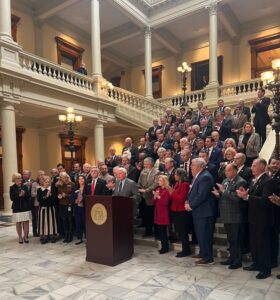
In Georgia, the Speaker of the House proudly announced a bold literacy bill, which among other reforms ensures a coach trained on structured literacy for every elementary school, a key GeorgiaCAN priority for 2026. The legislation has already built bipartisan support and will be heard in the House Education Committee next week. Meanwhile, the team’s bill to expand the Distraction Free Education Act to high school, which bans student phone use during the school stay, advanced unanimously through the House Education Committee.
TennesseeCAN, in collaboration with Excel in Ed, drafted a new legislative math package that includes math screeners, high-quality instructional materials, teacher certification reforms and auto-enrollment for advanced coursework for students who have demonstrated readiness. Governor Lee’s State of the State also announced support for a number of TennesseeCAN’s policy goals, including expanding access to Education Freedom Scholarship for 40,000 students, and a $40 million boost for charter school facilities.
TennesseeCAN Action Fund Executive Director Chelsea Crawford also penned an op-ed on new polling of Republican primary voters which was shared by leading gubernatorial candidate Marsha Blackburn.
On February 23, Brookings will host an event on increasing the supply of STEM teachers in light of recent teacher pipeline data.
Step Up for Students reports that in the first three days of the application process being open, over 200,000 students have applied for the educational choice scholarship in Florida.
Chad Aldeman is back to myth-busting in his latest piece on teacher turnover at Education Next, finding that despite declining teacher satisfaction, only 8% of teachers left the field according to the most recent federal data.
A new survey from Brookings finds strong support from both teens and adults for restrictions on cell phone use in school.
AEI’s Nat Malkus explores why we have failed to bring chronic absenteeism back to pre-pandemic levels and finds that both students and parents place less value on school attendance than they used to.
Black and Latino students are at significantly higher risk for post-pandemic chronic absenteeism, even when they had similar pre-pandemic absence profiles to their peers, according to new research published at EdWorkingPapers.
Fordham publishes a new analysis from Marguerite Roza that shows how districts can resource tutoring programs through redirecting the growing funding streams for administrative and support staff.
Research published at EdWorkingPapers suggests that academic interventions in early grades can have statistically significant, but modest, long-term effects on students’ executive functioning.
A new tool from Brookings enables users to compare pandemic student achievement trajectories for each grade-level cohort and state.
Urban Institute takes stock of changes to federal student loan policy and the impact it will have on borrowers, finding that the system has been made less confusing but has increased the risk for low-income students to default.

Patrick O’Donnell at the 74 Million reports on Genesys Works, a national internship program for high school students. After launching in 2002 in Houston, the program has expanded to eight cities: Chicago, Houston, Jacksonville, Minneapolis, New York, San Francisco, Tulsa and Washington DC, having already placed 1,100 students in internships at over 200 companies. Pictured, high school senior Najaax Sheikh Ali, explains her internship role of helping employees at her company deal with malfunctioning computers.