
















Week 338
It is week 338 and we are digging into all the data from the big new PISA release.
The headline: ...

Jump to: Top Tasks | From the Field | Key Resources | Moments of Resilience
It is week 318 and we are thinking about the growing enrollment crisis in our schools.
“The big shift here is from a surplus of kids to a scarcity,” Aaron Pallas, a sociology and education professor at Teachers College at Columbia University, told The New York Times in an important new article on declining enrollment in New York City schools.
Against these big headwinds, even charter schools that have previously bucked the downward trend are finding it hard to keep growing.
“During the past five years, Coney Island Prep was among the only charter schools in the city to experience an increase in enrollment without adding new grades,” Troy Closson, Matthew Haag and Jeff Adelson write in the NYT article. “Still, it is not immune from the declining population of children. Coney Island Prep used to have waiting lists across all grades. No more. They have increased the school’s marketing budget to $80,000 a year, buying YouTube and Facebook advertisements that target families in South Brooklyn, and partnered with nearby day care centers to raise the school’s profile among parents with young children.”
We first discussed this challenge three years ago in week 158 of this newsletter when we drew upon research by Education Data Collective’s Brian Eschbacher to make the case that ed reformers had to “get ready for the coming baby bust in big cities.” Now that baby bust is here and it is creating huge headwinds for school leaders not just in NYC but in cities across the nation.
We recently caught up with Eschbacher to find out what he has learned in the past three years of work helping entrepreneurial school leaders beat the odds in this new educational reality. In Education Data Collective’s unique database of more than 1,600 charter schools across the country, more than one in three charter schools experienced declining enrollment since 2019.
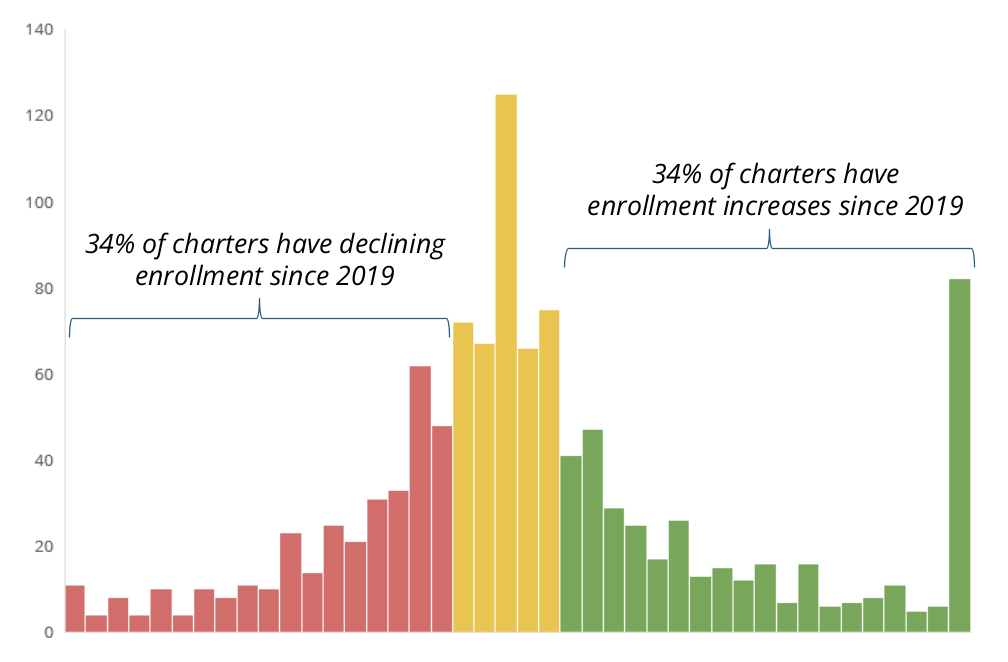
“The external and school-specific dynamics that are currently impacting enrollment apply to charter schools just like traditional public schools,” Brian Eschbacher explains in an interview with the Roundup. These include not only the lowest birthrates in American history but also the migration of families with young children away from Northern cities and increased competition between schools as educational choice programs have grown in size. What’s needed now, Eschbacher argues, is a new approach to enrollment and new school creation grounded in a much better understanding of the student population trends, the level of competition and the addressable market a school is aiming to serve.
What these new data analytics tools reveal are patterns of growth that have too many charter schools competing for students in some neighborhoods while leaving other parts of the city not served by charters at all. Eschbacher shared a map of charter elementary schools in San Antonio that reveals the growing problem in stark relief: each shape is the area within a five minute drive of a charter school with the colors showing the level of overlap with other charter schools, from green for no overlap to red for the highest levels of overlap.
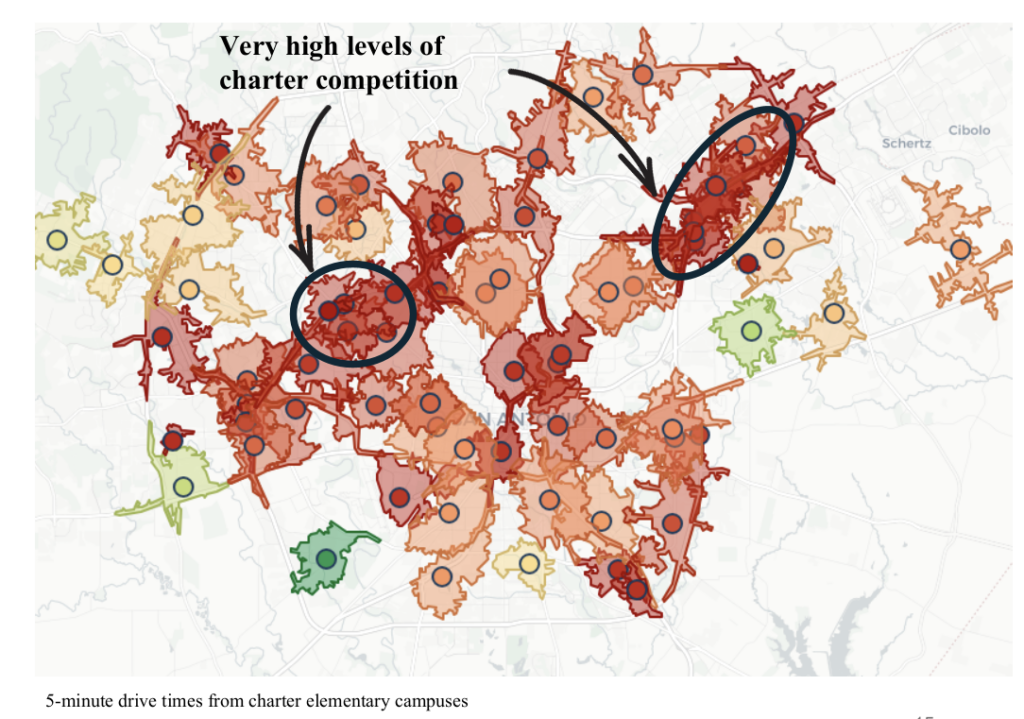
When it comes to the creation of new schools, the approach that worked in an era of growing student enrollment isn’t going to cut it in the baby bust era. The old charter school model treated enrollment as something to tackle after the big problems of facilities, staffing and curriculum were resolved. In this new era, that order of operations needs to be reversed. The schools that will thrive will treat enrollment as job number one.
Last time, in the New Reality Roundup, we looked at the reproducibility crisis in education research and checked in on GeorgiaCAN as they wrapped up a successful legislative session. This week, we check in on Hawaii, Tennessee and Connecticut as wins are solidifying in the final weeks of session.
“We’re in the ninth inning with three runners on base and now we need to bring them home,” HawaiiKidsCAN Executive Director David Sun-Miyashiro told us last week as the legislative session entered its final weeks. “This is already the furthest a literacy reform bill has ever gotten in the Hawaii legislature in many years, building on advocacy we kicked off with Kareem Weaver at the State Board of Education in 2024, but we can’t take anything for granted.”
HawaiiKidsCAN’s three primary 2026 legislative goals have cleared both chambers and are now headed to the conference committees where their fate will be decided. Despite the diverse subjects addressed – each requiring a slate of different partnerships and stakeholders – the team has built incredibly strong momentum and support:
“We’re pushing forward across a range of policies that we know are going to create more opportunities for Hawaii’s kids,” David reflected. “It’s a sign that legislators are really locked in on wanting to improve the K-12 education experience in our state. One of the advantages of being in a state long-term is that you become aware of the roadblocks that exist, and when you see some of those roadblocks clear, it’s a sign to push as much as you can at once.” For David, when he saw some key leadership changes in the legislature, he knew that the window of opportunity had opened and it was time to activate a painstakingly built critical mass of supporters and partners.
But it wasn’t just legislative turnover that created the opportunity. “I’ll give a lot of credit to my advocacy director, Erica Nakanishi-Stanis, because adding another set of hands to build deeper partnerships with the community has provided the juice we’ve needed,” David explains. “Whether it was bringing elementary students who are more passionate about literacy than some adults I know to the Capitol or sharing the stories of charter leaders who have all the talent to do great things for kids if they can just get a building… the outreach work is more critical than I ever thought before.”
The work isn’t done, David and Erica both caution. “In some ways, bills entering the conference committee is the most harrowing step in the advocacy process because things get foggier behind closed doors. Our role now is to keep the energy behind these bills moving and ensure any shifts made in conference don’t undermine the legislation.” One way the team is tackling that is by utilizing the media, with a trio of op-eds dropping last week to keep the pressure on.
“I’ve never been more proud and inspired to see such alignment and momentum around academic policies that put students first,” Chelsea Crawford, Executive Director of TennesseeCAN shared. “Just this past week, we’ve obtained two major school choice wins, both the expansion of Education Freedom Scholarships program to 35,000 seats next school year, and a historic investment of $40 million in charter school facilities funding on top of the already $22 million in TISA funding earmarked for our public charter school students. Taken together, these wins will have a life-changing impact for thousands of Tennessee kids and families.”
For the Education Freedom Scholarships, Chelsea successfully fought for a number of other policy improvements beyond growing the number of scholarships offered. “As a result of this legislation, parents and lawmakers will have additional transparency in who is participating in the program and much-improved prioritization for low-income families,” Chelsea explained, though it isn’t until she talks about the students impacted where she beams a smile. “Doing what’s best for kids is always our north star, and these wins will fulfill so many promises for families who are desperate to access quality education options for their kids.”
In a third policy win, similar to GeorgiaCAN‘s recently passed bill, the TennesseeCAN team has guaranteed automatic enrollment for advanced math pathways in middle school. “This is a big one,” Chelsea says. Currently less than half of middle schools in Tennessee offer Algebra I, but the new policy requires all middle schools to enroll their high performing math students in Algebra I in 8th grade, and ensures schools can actually implement this change by providing a new, free math certification for teachers that will give them the credentials to teach the coursework. “When we have half of the 150,000 of Tennessee’s 7th and 8th graders blocked from math opportunities, there’s just no way that we’re going to settle for excuses that leave our kids behind.”
These three wins are waiting on two more for Chelsea to nab a sweep of her policy goals this session.
Still to come? “Better Spending, Better Schools,” TennesseeCAN’s public school spending transparency bill, is the next step in a fight that Chelsea has been engaged in since she helped develop and pass the TISA funding formula. “I’m not sure if the frustration parents and the public feel towards wasted funds will ever evaporate,” Chelsea laughs, “but it is clear that’s a feeling among many of our legislators as well. Everyone understands how important it is to make expenditures in our system clear and comparable for the public. Better student outcomes don’t come from wasted funds.” Thus far, and surprising to Chelsea and her team, the bill has received unanimous support throughout multiple committees in the legislative process. The bill awaits a House floor vote this week and will be heard by the Senate Finance, Ways, and Means committee prior to final consideration on the Senate floor.
The team is also closing in on its defense of Tennessee’s system of assessment and school accountability, concluding a major effort underway since last year to stop efforts to draw down on public school testing. Channeling legislative frustration that there were just too many tests, the TennesseeCAN team took a thoughtful approach: walking elected leaders through how the state-required summative assessment can lead schools and districts to make strange choices, such as a dozen formative assessments throughout the year, and shining a spotlight on the need to get the real story.
“Legislators want and need the clarity this policy brings so they can make informed decisions around how we will measure student learning and hold systems accountable for results,” Chelsea said. “Under the new policy, Tennessee districts would be required to report the tests they are giving, to which students in which subjects and grades, and when those assessments are administered. That means, instead of an outright cancellation of the state TCAP assessment, we will find out for the first time exactly what testing burdens may exist and where we can work smarter to measure student performance.” The bill passed the Senate 27-3 and will be voted on the House floor vote this week.
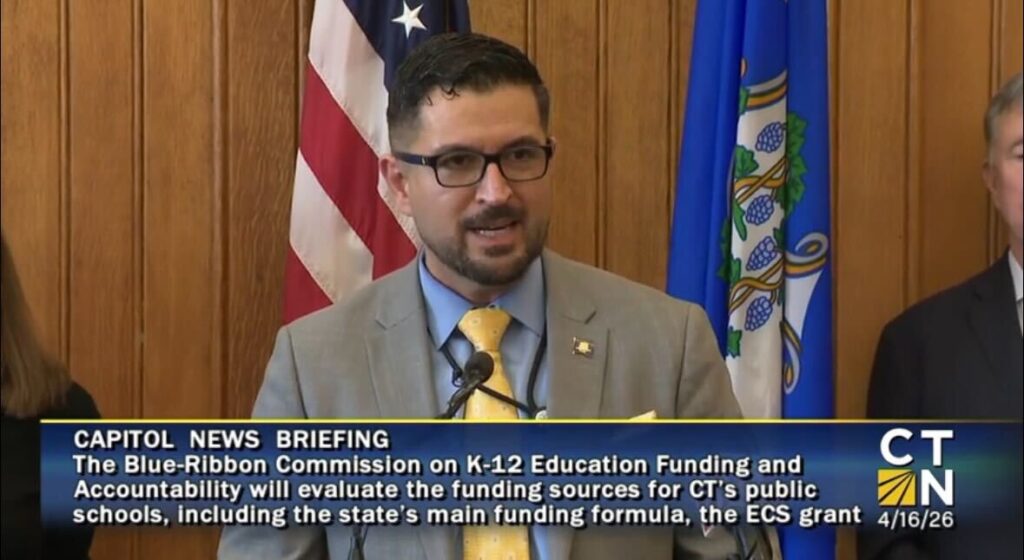
ConnCAN Executive Director Steven Hernández was featured in nearly every statewide paper last week, as he was appointed to Governor Ned Lamont’s BlueRibbon Commission on school finance. The commission will spend the next months developing legislative proposals for determining how the state can better fund schools.
The ConnCAN team is less than a month out from the close of session and are tracking progress toward a number of goals: the appropriations budget has funding for three new charter schools that the ConnCAN team guided through the approval process last year. The team is excited but also watchful. “We’re grateful to see this level of support for charters and choice in the budget, and we’ll keep working to make sure that commitment holds through the end of session,” Steve says. Also in the budget as a result of ConnCAN’s advocacy: $5 million for tutoring, and in an effort to address persistent educator pipeline issues: $4.5 million for the Aspiring Educator Scholarship, $2 million for a teacher apprenticeship program and $400,000 for TEACH Connecticut.
“The next big effort is around Senate Bill 220,” Steven explains, referencing a bill that would expand resources to struggling readers in grades 4-6. “We’re deep in negotiations with legislators and partners as we work toward a bill that will have robust support and that addresses some legislators’ concerns over costs, without a reduction in the program’s efficacy.”

At ASU-GSV, 50CAN VP of Policy Liz Cohen moderated a panel with Susanna Loeb, Ben Caulfield, Rahul Kalita and Antoinette Mitchell on the future of tutoring in American education and the role that AI might play. For even more insight into how tutoring and technology are merging to support educators and students, check out Liz’s discussion of what she learned at ASU-GSV on the Future of Tutoring Substack.
A week from this Tuesday, Urban Institute will host a conversation with policy minds, including Emily Gutierrez, Kunjan Narechania and Lindsay Fryer on shifting federal education policy.
CRPE’s Robin Lake, along with guest author (and National Voices alum) Travis Pillow chart two paths for public school districts as competition to fill seats has heightened.
Bellwether will speak with Sonja Santileses next week, as she prepares to exit the role of CEO of Baltimore City Public Schools after over a decade of leading education in the city.
Researchers from the University of Texas at Dallas present findings at EdWorkingPapers that show Algebra I enrollment grew by over 11% by automatically enrolling students and providing an opt-out option.
The Economist suggests that the reason elder children outperform their younger siblings in educational achievement has to do with a microscopic culprit: germs.
At AEI, Rick Hess interviews Harvard Graduate School of Education lecturer Michael Horn on AI in schools, with Horn suggesting, “the learning model will always matter more than the technologies used.”
Covid-era disruptions led to persistent, global learning crisis with widening inequalities according to new research published in the journal Learning and Instruction, which shows that globally student achievement fell .11 SD overall and .23 SD for low-achieving students.
Cumulative years of homelessness result in significantly lower math and ELA achievement, research at EdWorkingPapers shows, particularly when students are in middle school.
At Fordham, Jay Plasman and Aaron Churchill offer five findings from their study of industry-recognized credentials in Ohio, including a short-term wage increase for credential holders that grows higher when paired with a career and technical education course.
A study at EdWorkingPapers finds that state-based merit aid programs neither increase degree attainment nor long-term in-state residency rates.

VELA shares the story of the Free Haven Forest School, located outside of Chicago, which provides a year-round, nature-based education for over 400 students. A full suite of math, science, history and reading coursework are coupled with hiking, plant identification and wild medicine, with every one of the classes held outdoors. “When nature is your classroom, you’re never going to run out of things to learn about, to be curious about, or to ask questions about,” school founder Rachel Mikottis shares.